Tuesday, 31 August 2010

amateur observing - Please take the time to visit Meta!

A lot of you are probably already aware of our meta site, but I wanted to take the time to remind you that it only requires 5 reputation points to participate--and this is a critical part of our site. Meta is where we decide what kinds of questions we like in the community, it is where we pick our topic of the week, it is where we can deal with different issues of site growth. Did you know that we could start a blog if we wanted to? These are the types of things that meta allows us to discuss. In fact, this post would be best suited on meta because it is not about the field of astronomy, but about this site. I have posted it here so that you (especially new users) can see it. Maintaining activity on our meta site is important to the long term health of our site. If we don't have activity there, we could wither and ultimately get shut down. I appreciate the recent surge of questions, but I hope that many of you will stick around and participate in making this site work!


For more on Meta, read this blog post. Though, note that the link to meta is now located under the dropdown on the black top bar.


Also check out this blog post on the important questions to ask on Meta.


Thanks for your continued contribution to Astronomy !

Friday, 27 August 2010

earth - From what distance can one object influence gravity of another object?


What id like to know, in what distance do they have to be from each other to create only one gravitational influence.


At whichever point you decide to call them two objects rather than one object. It's a completely arbitrary choice that depends on you rather than gravitational physics. What's going on is that gravity can be described by a mass density distribution, and which part of that distribution corresponds to "one object" and which to "another object" isn't important.


You may be confused by Newton's law of gravity that says the gravitational force force is proportional to the product of the masses and inversely proportional to the distance between them squared. But this law only applies to spherically symmetric objects. It only applies to you exactly if you're a spherical cow.


This kind of arbitrariness actually applies to the Earth as well. Even if the Earth were perfectly spherically symmetric, one could say that Earth's gravity is due to the influence of the northern hemisphere and the influence of the southern hemisphere, etc. Whether you consider the Earth to be one object, or two, or a trillion, depends on you.


The Earth isn't spherically symmetric. It's closer to an oblate spheroid, since it bulges at the equator. But it isn't exactly that either, having mountains or other topographical feature, to say nothing of mass density variations inside the Earth. In principle, one could describe its gravity including people and trees or whatnot. Gravitationally, there is no fundamental difference between you and some rock. That you consider yourself to not be "part of Earth" is a choice you make for other reasons.


If you distance yourself from the Earth, there is a difference because the mass distribution would change. But again, whether you consider this to be "only one gravitational influence" or "the Earth plus you" is up to you, and this holds true regardless of whether you distanced yourself or not.

distances - What is the formula to figure out how far away a star is?

One method involves finding a cepheid variable in the vicinity of the star, or even in the galaxy you are investigating. These stars vary in brightness with a period closely related to their absolute magnitude. By measuring the period, you can know how bright it would appear at a distance of, say, one light year. Using a photometer, you can measure it's apparent magnitude, and figure out how far away it must be for you to see it as you do.


From the referenced web page:


In 1924 Edwin Hubble detected Cepheids in the Andromeda nebula, M31
and the Triangulum nebula M33. Using these he determined that their
distances were 900,000 and 850,000 light years respectively. He thus
established conclusively that these "spiral nebulae" were in fact
other galaxies and not part of our Milky Way. This was a momentous
discovery and dramatically expanded the scale of he known Universe


For another Method, imagine this:


Look carefully at Sirius with your naked eye tonight. Tomorrow, take a piece of brass with small holes a varying size, and see which one, when held up to the sun, seems as bright as Sirius. Knowing the area of that hole, knowing what fraction of the area of the sun's disk you could see through that hole, and assuming the sun is a star just like Sirius, you now know how bright the sun would be if it were as far away as Sirius, and you can make an educated guess how far Sirius is from the Earth.


If it's around 1650, you're Christiaan Huygens, and you assume all stars are the same, then you've made a massive contribution to our understanding of the universe. However, since the Sirius puts out something like 25 times as much light as the sun, Huygens answer was only some 30,000AU, an epic underestimate. Still, the first scientific evidence hinting at the true size of our universe.

Wednesday, 25 August 2010

Any possibility for life on moons of planets in our Solar System

If you check 2001 A Space Odyssey saga, Europa is actually a satellite with Life.


Coming back to real space, the "comfort zone" for life is approximately from Venus' orbit to Mars' orbit. There, only Moon, Phobos and Deimos are satellites, and all of them are too dry to have any kind of life.


Beyond the comfort zone you need some other way for water not to frozen (a commonly referred prerequisite of Life), so you'll need a volcanic or tidal-heatened satellite. There are a few of these. Europa and Io come to my mind just now. Life there could be possible.

earth like planet - Why is carbon so rare on the Moon and on Mars?

There is not much doubt that the abundance of carbon in the protosolar nebula was not abnormal. We can tell that by looking at the carbon abundance in the atmosphere of the Sun - it has an abundance of 8.43 on a logarithmic (base 10) scale where hydrogen has an abundance of 12 (Asplund et al. 2009). This is typical for stars in the solar neighbourhood.


However carbon in the solids of the solar system - i.e. in the Earth, moon, meteorites etc. is underabundant with respect to this by something like a factor of 10. Nitrogen is similarly underabundant in the Earth and oxygen to a lesser extent (a factor of two). (Lodders et al. 2009)


The reason for this is that C,N,O are all capable of remaining in the gaseous phase at the kinds of condensation temperatures that are typical for forming most of the "rocks" that make up the Earth and other solids in the solar system. In particular, carbon monoxide is readily formed at high temperatures and cannot easily be captured into terrestrial planets and other rocky materials.

Tuesday, 24 August 2010

fundamental astronomy - How can we be 13.2 billion light years from another galaxy?

Don't think of inflation as super luminal movement of our galaxy from others. Think about the 'stuff' that makes space-time between the galaxies simply increasing (this is inflation). This causes the light to travel through more and more 'stuff' as time is passing by.


Imagine a clump of space-time A, and another B, next to each other at the start of the Big Bang. Then add some more clumps of space-time between them. You wouldn't think that the objects within space-time A and B have actually moved. A really basic analogy would be two pool balls next to each other with an ant on each. The ants can only travel to the next ball by walking on the the balls (ignore the ground). Then imagine the same scenario, but you add another ball between them. The ants haven't moved on the balls, but they would have to travel further now to get to the ball the other ant is on. The balls in the example would represent space-time, and the ants any galaxy/star.

Saturday, 21 August 2010

stellar evolution - Without using absolute magnitudes or isochrones, how might we tell a star's age and evolutionary status?

The spectra of a red giant and a red dwarf are completely different, so there isn't really too much to say about this. For example, alkali lines are almost non-existent in red giants, but strong in red dwarfs. The theory as to why this happens is the stuff of a standard graduate/undergraduate course on stellar atmospheres, not an SE answer.


The fact is that a R=50,000 spectrum with decent signal to noise ratio will quite easily
give you the temperature (to 100K), surface gravity (to 0.1 dex) and metallicity (to 0.05 dex), plus a host of other elemental abundances (including Li) to precisions of about 0.1 dex.


What can you do with this:


You can plot the star in the log g vs Teff plane and compare it with theoretical isochrones appropriate for the star's metallicity. This is the best way to estimate the age of a solar-type (or more massive) star, even if you don't have a distance and is the most-used method. How well this works and how unambiguously depends on the star's evolutionary stage. For stars like the Sun, you get an age precision of maybe 2 Gyr. For lower mass stars, well they hardly move whilst on the main sequence in 10Gyr, so you can't estimate the age like this unless you know the object is a pre-main sequence star (see below).


You can look at the Li abundance. Li abundance falls with age for solar-mass stars and below. This would work quite well for sun-like stars from ages of 0.3-2Gyr and for K-type stars from 0.1-0.5 Gyr and for M-dwarfs between 0.02-0.1 Gyr - i.e. in the range where Li starts to be depleted in the photosphere and where is is all gone. Typical precision might be a factor of two. A high Li abundance in K and M dwarfs usually indicates a pre main sequence status.


Gyrochronology is not much help - that requires a rotation period. However you can use the relationship between rotation rate (measured in your spectrum as projected rotation velocity) and age. Again, the applicability varies with mass, but in the opposite way to Li. M-dwarfs maintain fast rotation for longer than G-dwarfs. Of course you have the problem of uncertain inclination angle.


That brings us to activity-age relations. You can measure the levels of chromospheric magnetic activity in the spectrum. Then combine this with empirical relationships between activity and age (e.g. Mamajek & Hillenbrand 2008). This can give you the age to a factor of two for stars older than a few hundred Myr. Its poorly calibrated for stars less massive than the Sun though. But in general a more active M-dwarf is likely to be younger than a less active M dwarf. It should certainly distinguish between a 2Gyr and 8Gyr M dwarf.


If you measure the line of sight velocity from your spectrum, this can give you at least a probabilistic idea of what stellar population the star belongs to. Higher velocities would tend to indicate an older star. This would work better if you had the proper motion (and preferably the distance too, roll on the Gaia results).


Similarly, in a probabilistic sense, low metallicity stars are older than high metallicity stars. If you were talking about stars as old as 8Gyr, these would be quite likely to have low metallicity.


In summary. If you are talking about G-dwarfs you can ages to precisions of about 20% using log g and Teff from the spectrum. For M dwarfs, unless you are fortunate enough to be looking at a young PMS object with Li, then your precision is going to be a few Gyr at best for an individual object, though combining probabilistic estimates from activity, metallicity and kinematics simultaneously might narrow this a bit.


As an add-on I'll also mention radio-isotope dating. If you can measure the abundances of isotopes of U and Th with long half lives and then make some guess at their initial abundances using other r-process elements as a guide then you get an age estimate - "nucleocosmochronology". Currently, these are very inaccurate - factors of 2 differences for the same star depending on what methods you adopt.


Read Soderblom (2013); Jeffries (2014).
telescope - How can I use Polar Alignment to find objects in the sky?

If a mount is polar aligned, it becomes very easy to find objects that have the same Right Ascension or Declination as a bright star. It works like this


1) you align the mount to the pole


2) using a star map, or an app, you try to find an object that has the same R.A. or declination as a bright star. As an example, use Messier 4, which has almost the same declination as Antares.


3) you point the telescope at Antares. Lock the declination axis.


4) Look through the finder, or through the scope using the eyepiece that gives you the biggest field of view. This most often this is the eyepiece that gives you the lowest magnification.


5) move the scope to the west, it rotates around the RA. axis. Messier 4 should now enter the field. Move slowly, and move back to Antares when you get lost.


6) When you see Messier 4, lock the RA. axis too, and center Messier 4 in the field using the fine adjustment controls.


7) There are a couple of other bright objects you can try. I'm not familiar with the Southern sky, but for the Northern sky, Messier 13 can be found starting at eta Her(cules), and moving in declination.


8) a bit harder is Messier 57 in Lyra, you need to start a bit to the north of gamma Lyr, or a bit to the south of beta. Another easy target is IC 4665, which is very close to Beta Ophiuchi (Cebalrai), almost but not quite to the north.


9) Other objects to try are Messier 5 starting with Beta Librae (Zubeneschamali), and Messier 10 starting at epsilon Ophiuch (Yed Posterior).


10) The next step is to try and find objects by using multiple steps, alternating between moving in RA and in declination. You would move to a star or better, to a recognizable star pattern, and continue from there.


11) This way of star hopping works best if the angles moved are not huge. Think 10, 15 degrees. As you get more experienced you will start using the stars in between as waypoints so you can move bigger distances.

Friday, 20 August 2010

Can I measure the moon's gravity?


Running the math for a 5 meter long pendulum and 1 kg mass, I get an amplitude of 0,017 mm.


You are off by quite a bit. There is essentially no horizontal deflection when the Moon is at the horizon. The maximum horizontal deflection occurs when the Moon is about 45 degrees above or below the horizon.


The tidal acceleration at some point on the surface of the Earth due to some external body (e.g., the Moon) is the difference between the gravitational acceleration toward that external body at the point in question and the gravitational acceleration of the Earth as a whole toward that body:


$$vec a_{rel} = GM_text{body} left(frac {vec R - vec r} {||vec R - vec r||^3} - frac {vec R} {||vec R||^3} right)$$
where


  • $M_{body}$ is the mass of the external body,

  • $vec R$ is the displacement vector from the center of the Earth to the center of the external body, and

  • $vec r$ is the displacement vector from the center of the Earth to the point in question on the surface of the Earth.

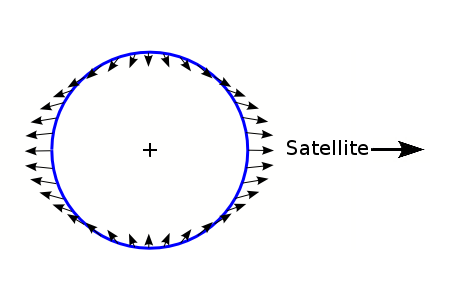
The resultant force looks like this:


Note that the tidal force is away from the center of the Earth when the Moon is directly overhead or directly underfoot, toward the center of the Earth when the Moon is on the horizon, and horizontal when the Moon is halfway between directly overhead/underfoot and on the horizon.


The tidal force is maximum when the Moon is directly overhead, and even then it's only about 10-7g. You need a sensitive instrument to read that. A simple pendulum or a simple spring will not do the trick.

Thursday, 19 August 2010

galaxy - Where does the Milky Way end?

Update for clarity:


For the visible part of a standalone galaxy, the stars can all be measured to orbit that galaxy's core. So if you wanted to measure the furthest extent at this simplified level, it would be very easy. The problem is that there is a lot of mass which is not stars, and which is dark matter. Some of it is so far out, it may be impossible to calculate what it is orbiting.


If you read the paper, you will see that they chose a limit beyond which the effect of the negligible mass further out was not relevant to this calculation.


A galaxy can be thought of as a flattened sphere, as regards mass. Stars, at least for spiral galaxies, tend to lie in a plane, but there is mass orbiting the common centre in all planes. So there is no start point, there is just a need to decide how far out we want to say the galaxy extends.


For the Milky Way and Andromeda, a decision has been made that is the same for both (the exact decision doesn't appear to have been published for this paper, but as long as it is consistent, then the relative masses will be correct)


For galaxies that are colliding or near to each other it is much more difficult - do you calculate which galaxy a star belongs to by the direction of its motion? Stars may swap from one to the other. From Wikipedia's Milky Way page:


Surrounding the Galactic disk is a spherical Galactic Halo of stars and globular clusters that extends further outward, but is limited in size by the orbits of two Milky Way satellites, the Large and the Small Magellanic Clouds, whose closest approach to the Galactic center is about 180,000 ly (55 kpc).[51] At this distance or beyond, the orbits of most halo objects would be disrupted by the Magellanic Clouds. Hence, such objects would probably be ejected from the vicinity of the Milky Way.


tl;dr - it's a pretty arbitrary decision :-)

Sunday, 15 August 2010

Rotation and relativity - Astronomy

When a planet is spinning around its own axis, it has an effect on the trajectory of its satellites. I believe it is called frame dragging.


Spin increases the kinetic energy of an object, contributing to its mass-energy, but some other effect must come into play as well.


How does one differentiate between spin and orbit velocity?


What is the effect of the spin? Lets say that Earth suddenly started spinning faster, what would happen to the moons trajectory?

Friday, 13 August 2010

orbit - Spotting the International Space Station (ISS)

The official site you point to has 3 pieces of location information:
1) the max height angle
2) the point it appears
3) the point it disappears
The only one of these that is especially accurate is the max height angle, and that isn't the number you want to use to try and see it. However, passes with a bigger number for the max height angle will be easier to see.


To find the ISS, get the reference to the point it "Appears" - that is the "11 above N" you have described. Now, notice that the reference to the compass direction is simply N or NNE or SW or whatever. This is not a precise directional reference, but it doesn't need to be, as if you're looking towards that direction, you shouldn't have any problem seeing ISS appear. It isn't clear to me if the website is using True North or Magnetic North for the direction; Magnetic North might be easier for people with a simple compass to find, but usually these directions will be relative to True North, which is not where a compass points. From a quick check using my own location, it appears that they have used True North, which is maybe a bit unfortunate. If you don't know where True North is for your location, you can look it up, and then you have to remember to adjust the reading off your compass by the offset for your location.


Notice that the description is "11 above N". This means 11 degrees above the N direction. The reason for it appearing some distance above the horizon is because it is coming up out of the shadow of the Earth, which is being cast some distance above the horizon.


To quickly and easily estimate angular distances, use the trick of observing your hand at arms length. Different parts give different angular dimensions. It is a pretty fair estimate, because no matter how big or small you are, the relative size of your hands and the length of your arms is probably about the same as everyone else... not good enough to use as a survey instrument, but good enough to guesstimate locations on the sky.


The second position description is the "Disappears" location. That is where the ISS will again drop into the shadow of the Earth. Similarly, it is described as degrees above a True North compass direction.


You can figure out (approx) the path the ISS will take by drawing an imaginary line between these two points. However, don't draw that imaginary line so it goes over your head, note the "Max Height" angle again: this is the highest point on the line that you draw between the "Appears" and "Disappears" spots.


Just give it a go, especially one with a pass that starts around 30mins or so after sunset, and that has a high "Max Height" angle. It won't be hard to see.

fundamental astronomy - Which is the shape of the sky?

For computer software, the easiest way to take a sphere (and/or hemisphere) and flatten it into a flat shape (usually a rectangle) is the equi-rectangular projection (also known as the plate carrée), because it has the simplest formula relating pixels and coordinates:


$x = w*lambda/360 + w/2$


$y = -h*phi/180 + h/2$


x and y is the pixel point


w and h are the width and height (in pixels) of your map's rectangle


$lambda$ (lambda) is the longitude in degrees and $phi$ (phi) is the latitude in degrees


This all assumes that your map puts the 0 longitude, 0 latitude point in the center. In other words, the prime meridian runs down the map's middle vertically and the equator runs down the map's middle horizontally. It also assumes that north and east are positive, while west and south are negative.


Notice that you don't even have to take the sine or cosine of anything. That's why the equi-rectangular projection is so simple. It basically just takes longitude and latitude and makes them x/y coordinate with only an offset. The offset comes because, usually in computer programming, the origin is at the top left instead of the center of the screen.


Notice also that I negated the latitude in the y formula, because most computer systems in 2D coordinates have the positive y direction pointing down. This is opposite of a standard graph in math, where positive y goes up.


In your case, longitude and latitude will actually be Right Ascension and Declination respectively. They are basically stellar coordinates for the celestial sphere as opposed to ground coordinates for the geode.


There are many, many other map projections possible, but equi-rectangular is the simplest.


However, your question is a little vague because you mentioned a "virtual 3D world", yet also asked how much you need to flatten it. If you already have a 3D model of a sphere in your computer graphics, you don't have to flatten it at all. You just draw the 3D model (sphere) with a texture on it. If you want to represent it as a map, then of course you have to flatten it, and equi-rectangular projection is the simplest way.

Thursday, 12 August 2010

sky survey - How to detect emission lines in optical spectra?

The programs I am aware of that you could use do require some programming expertise to operate. I would recommend looking at either IRAF (or PyRAF, which uses Python to interface with IRAF), or SPECTRE. Unfortunately, I'm not aware of a "black box" solution where you can just press a button and go.


SPECTRE is written in FORTRAN77 and is quite easy to use once you get the hang of it, though it has a somewhat limited feature set and the documentation is brief. It will help you to manually fit Gaussians to spectral lines, giving their central wavelengths and equivalent widths. A caveat for SPECTRE is that it requires the plotting package SuperMongo, which is not free software. If you are affiliated with a university, most Physics and Astronomy departments should have a license.


IRAF is a quite fully-featured, free, cross-platform application purposefully built for astronomical image analysis. It can help you measure the spectral lines, and can analyse the spectrum to determine the object's radial velocity.

Wednesday, 11 August 2010

earth like planet - How should exoplanet discoveries affect SETI?

Well you are correct and of course that kind of research has been going on. The SETI programme targeted a set of Kepler stars with evidence for a planet (or planet candidate) in the "habitable zone". The initial searches for narrow-band radio emission (at 1.1-1.9 Hz) appears to have concentrated on those systems containing multiple planets.


The (null) results for $sim 100$ system were published by Siemion et al. (2013). The observations were not sensitive enough to detect the sort of "radio chatter" emitted from our planet, but might have detected some sort of deliberate signalling beacon.


A slightly more imaginative approach, which I'm struggling to find the details of, is that one can observe Kepler multiple planet systems when one calculates that two planets are in conjunction as seen from the Earth. There is then the chance of seeing communications from one planet to the other. (e.g. http://adsabs.harvard.edu/abs/2014ebi..conf..5.2K ).


In a more general sense, the exoplanetery discoveries have provided great impetus to the SETI programme. It is now clear that planetary systems are common and present around most stars. It is also now apparent that small planets are common. New possibilities are also being considered. Most exoplanets in habitable zones are orbiting stars smaller and less luminous than the Sun. No exact Earth analogues have yet been found. This has led to an explosion of activity investigating planetary atmospheres and habitability around K- and M-dwarf stars.

photography - How are the photos of the Milky Way taken?

We are situated inside the galactic disk. The first image below, showing our approximate location, is a fabrication rather than a photograph. Such a photo would require a space probe to be tens of thousands of light years above the plane of the disk, which is patently infeasible with current technology. We don't even know exactly how many spiral arms our galaxy has!


But from where we are, we can still see a great density of gas and dust stretching 360 degrees across our sky, as you look along the galactic plane. These "inside views" are indeed real photographs - much the same as if you go outside on a dark night, well away from the city lights, you yourself will see its faint, dusty outline much like in the second image (which I can assure you is real).


enter image description here


enter image description here

Friday, 6 August 2010

formation - What does observational evidence say about the number of protoplanets believed to exist in the early solar system?

Earth and moon are thought to be formed by the collision of two planets. So we have at least these two protoplants. The cores probably ended mainly in the core of Earth; that's inferred by the much higher mean density of Earth in relation to Moon.


Iron-nickel meteorites strongly indicate at least one pre-existing planet large enough to form an iron-nickel core.


Comets of the Kuiper belt are hypothized to be a collision product.


As you go further back in time the building blocks of planets get ever smaller and more numerous till the interstellar dust and supernova remnants our solar system is formed of.


Some of the early material will most likely have been ejected from the solar system; this may include protoplanets.


By the chaotic nature of multi-body systems like our solar system it's getting more and more difficult to track single bodies back into the past.


The NICE models try to describe the early solar system.

solar system - Planets and Pluto? Neptune?

I answered this same question at physics.SE. I specifically joined this part of the SE network to address this duplicate question at this site.


The astronomy community faced two crises with regard to what constitutes a "planet", first in the mid 19th century, and more recently at the start of the 21st century. The first crisis involved the asteroids. The second involved trans-Neptunian objects. Both crises challenged astronomers to question what a "planet" was.


1 Ceres, 2 Pallas, 3 Juno, and 4 Vesta were discovered in quick succession during the first decade of the 19th century. There was no international astronomical organization at the time of these discoveries; the International Astronomical Union wouldn't be formed for another century. Instead, the designation of what constituted a "planet" fell on the major astronomical almanacs such as the Berliner Astronomisches Jahrbuch (BAJ). Those discoveries at the start of the 19th century were treated as newly discovered "planets". This situation remained static for about 40 years.


That changed in 1845 with the discovery of 5 Astraea. During the 1850s, the list of objects orbiting the Sun grew to 50, and during the 1860s, the list grew to over 100. The response of the BAJ and others was to demote Ceres, Pallas, Juno, and Vesta from planethood status to some lesser status, either minor planet or asteroid. Astronomers didn't have a clear-cut concept of what constituted a planet other than that they should somehow be large. Ceres, the largest of the bunch, is not very large. The end result of all of these discoveries starting in 1845 was that the first four discovered asteroids were demoted from planethood status.


The second crisis started in 1992 with the discovery of (15760) 1992 QB1. By 2006, the number of trans-Neptunian objects had grown significantly. Were these things "planets", or something else? Some astronomers, notably Alan Stern, wanted the term "planet" to be extremely inclusive. Most astronomers balked at this idea.


Paradoxically, it was Alan Stern himself, along with Harold Levison, who provided the key criterion of "clearing the neighborhood" that lies at the heart of what the IAU deems to constitute a "planet." Their paper, Stern and Levison, "Regarding the criteria for planethood and proposed planetary classification schemes," Highlights of Astronomy 12 (2002): 205-213 suggested splitting "planet" into two categories, "überplanet" (Mercury, Venus, Earth, Mars, Jupiter, Saturn, Uranus, and Neptune) and "unterplanet" (Pluto+Charon, Eris, Ceres, Sedna, and a host of others).


Stern is being quite hypocritical when he rants that there is no clear-cut boundary between "planets" and "dwarf planets." The boundary is huge, and Stern knows this. The ratio of the square of an object's mass to its orbital radius about the Sun is key in determining whether an object can clear most of the junk from the vicinity of the object's orbit. There is a five order of magnitude difference between the smallest of the planets and the largest of the dwarf planets in terms of this ratio. This five order of magnitude difference figures predominantly in that paper by Stern and Levison.


The only difference between the proposal by Stern and Levison versus the voted-upon IAU resolution is that while Stern and Levison wanted to designate hundreds (and perhaps thousands) of objects into subcategories of "planet" ("überplanet" and "interplant"). On the other hand, the IAU chose to designate those objects as the mutually exclusive terms "planets" and "dwarf planets". This is consistent with how astronomers dealt with that first crisis. Planets should be "large." Stern and Levison provided the necessary ammunition to distinguish large from not so large.

Wednesday, 4 August 2010

expansion - Does the universe expand at the same rate everywhere in the universe?

What's outside the observable Universe, we can't say anything about, but averaged over large enough scales ($gtrsim$ a billion lightyears), it does indeed seem to be expanding uniformly.


However, the presence of mass, or more generally energy, retards the expansion. This means that on the scale of clusters of galaxies, the Universe expands more slowly, and on the scale of galaxy groups, the galaxies' mutual gravitational attraction will prevent them from receding from each other. This is also why our galaxy, Solar system, planet, and bicycles will never get torn apart (unless the cosmological constant is not a constant).


Conversely, in mass underdensities, i.e. the huge voids between clusters and filaments of gas and galaxies, expansion is increased (relative to denser regions). In fact, it has been hypothesized that that the observed accelerated expansion of the Universe is not due to dark energy, but could be an "illusion" from accidentally living in the center of a huge underdensity (e.g. Zibin et al. 2008). More recent observations seem to rule out this possibility, though

Sunday, 1 August 2010

How do you calculate the effects of precession on elliptical orbits?

A good starting point would be <insert name of some scientist from long ago> planetary equations of motion. For example, there are Lagrange's planetary equations (sometimes called the Lagrange-Laplace planetary equations), Gauss' planetary equations, Delaunay's planetary equations, Hill's planetary equations, and several more. The common theme amongst these various planetary equations is that they yield the time derivatives of various orbital elements as a function of the partial derivatives of the perturbing force / perturbing potential with respect to some generalized position.


In general, the only words that can describe the result of this process at first is "hot mess." A hot mess did not deter those brilliant minds of old. Via various simplifying assumptions and long term time averaging, they came up with fairly simple descriptions of, for example, $left langle frac{domega}{dt} rightrangle$ (apsidal precession) and $left langle frac{dOmega}{dt} rightrangle$ (planar precession). You can see some of this in the cited 1900 work by Hill below.


While these techniques are old, these planetary equations are still used today. That sometimes you do get a "hot mess" is okay now that we have computers. People are using planetary equations coupled with geometric integration techniques to yield integrators that are fast, accurate, stable, and conserve angular momentum and energy over long spans of time. (Normally, you can't have all of these. You're lucky if you get just two or three.) Another nice feature of these planetary equations is that they let you see features such as resonances that are otherwise obscured by the truly "hot mess" of the cartesian equations of motion.


Selected reference material, sorted by date:


Hill (1900), "On the Extension of Delaunay's Method in the Lunar Theory to the General Problem of Planetary Motion," Transactions of the American Mathematical Society, 1.2:205-242.


Vallado (1997 and later), "Fundamentals of Astrodynamics and Applications", various publishers.
Other than the hole it punches through your wallet, you can't go wrong with this book.


Efroimsky (2002), "Equations for the keplerian elements: hidden symmetry," Institute for Mathematics and its Applications


Efroimsky and Goldreich (2003), "Gauge symmetry of the N-body problem in the Hamilton–Jacobi approach." Journal of Mathematical Physics, 44.12:5958-5977.


Wyatt (2006-2009), Graduate lecture course on planetary systems, Institute of Astronomy, Cambridge.
The results of the Lagrange planetary equations are presented on slide 6.


Ketchum et al. (2013), "Mean Motion Resonances in Exoplanet Systems: An Investigation into Nodding Behavior." The Astrophysical Journal 762.2.

supernova - Black dwarf binary systems

I know black dwarf stars do not exist yet, and that they are what white dwarfs end up after a long time. The question is really simple: would it be possible to have a binary system in which one of the two is a black dwarf, and the other companion star is dumping mass on the black dwarf, causing the black dwarf to supernova? I guess based on the timescales, the maximal initial mass of the second object could be calculated to see if it is possible that one object is at the black dwarf stage and the other still a giant. Or is the timescale on which the star goes from white dwarf to black dwarf big enough that it will never reach the black dwarf stage while the other one is still an AGB star?


Second part: If not possible that one is black dwarf and the other AGB star, is it possible if the companion is a brown dwarf, that they are close binary, and that a brown dwarf would dump mass on a black dwarf? This would need the binary system to be a very close binary system at this stage of the system.


Third part of the question: would the spectrum of the supernova be any different from the normal one with a white dwarf and a companion AGB star? I guess the spectral lines would be different, since the companion would have to be a very low-mass AGB star, since that companion would be about 20billion years or so, when the black dwarf star becomes a black dwarf.

orbital elements - How many observations does it take to determine the orbit of a TNO

The main problem with determining an object's orbit is we only know the position with certainty in two dimensions. The distance to the object is largely unknown. This accounts for the large uncertainty in the period of newly discovered TNOs. Many possible orbits could fit the early observations, and therefore the uncertainty is large.


As time goes on, and more observations are made, more and more of these possible orbits are excluded and the orbit fit becomes more exact.


So to answer your question, it really depends on how exact you want the answer, and how good your observations are. The more observations you take, and the better they are, the closer your orbital fit becomes. And more importantly, the bigger the arc of the orbit your observations cover, the more accurate the orbit becomes. It is impossible to give a specific number.


To give a practical example, Pluto takes 248 years to orbit the Sun. It was discovered in 1930, so we've only observed it for 85 years, or about 1/3rd of one orbit. One of the problems the New Horizons probe sent to Pluto had to overcome was that we didn't know, at launch, exactly how far away Pluto was, so therefore we didn't know exactly when New Horizons would pass the dwarf planet. That made it difficult to tell the probe where to point to take pictures at closest approach.

space time - What shape are black holes theorized to be?

It's complicated, and it depends on what you mean by "black hole".


In general, for a distant observer, the "black hole" is the event horizon - the surface within which there is no escape to the outside. The more massive the black hole, the bigger the event horizon.


http://en.wikipedia.org/wiki/Event_horizon#Event_horizon_of_a_black_hole


If the black hole is not rotating, the event horizon is a sphere, plain and simple. In a perfect vacuum, and if the black hole is big enough (is not microscopic), looking at it you'll see a perfectly black, round "thing", with the stellar background behind it.


enter image description here


However, the background image near the black hole would be distorted as if seen through a bad lens. This would become apparent as you move around it. This is because the powerful gravity of the BH bends the rays of light. See the first half of this video:


https://www.youtube.com/watch?v=8s-pWPqFQBE


If the black hole is not in a perfect vacuum, but is surrounded by various pieces of matter, it may capture that matter, and an accretion disk will grow around it.


enter image description here


If the black hole is rotating, things are a bit more complicated. This is an object described by the Kerr metric, and it has two important surfaces: the usual event horizon, and the outer skin of the ergosphere:


enter image description here


Nothing can escape from within the event horizon. It is possible to escape from within the ergosphere if you rotate with the black hole - this is known as the Penrose process.


I was not able to find visualisations of a Kerr (rotating) black hole, but it should look somewhat similar to a non-rotating one, except it would appear "flattened" at the poles, and bulging at the equator.