Tuesday, 31 May 2011

fundamental astronomy - Why didn't Johannes Kepler use data about more planets?

I know that quoting Wikipedia is frowned upon here, but as there has been no other answer posted, this is what the Wikipedia article on Kepler has to say about the matter:


He then set about calculating the entire orbit of Mars, using the geometrical rate law and assuming an egg-shaped ovoid orbit. After approximately 40 failed attempts, in early 1605 he at last hit upon the idea of an ellipse, which he had previously assumed to be too simple a solution for earlier astronomers to have overlooked. Finding that an elliptical orbit fit the Mars data, he immediately concluded that all planets move in ellipses, with the sun at one focus—Kepler's first law of planetary motion. Because he employed no calculating assistants, however, he did not extend the mathematical analysis beyond Mars. By the end of the year, he completed the manuscript for Astronomia nova, though it would not be published until 1609 due to legal disputes over the use of Tycho's observations, the property of his heirs.[Caspar][Koyré]


[1] Caspar M., Kepler, pp. 131–140;


[3] Koyré A., The Astronomical Revolution, pp. 277–279

Friday, 27 May 2011

earth - What will a lunar eclipse look like from moon?

During a lunar eclipse on Earth, the Sun would be eclipsed by the Earth as seen from the Moon:


$hspace{3cm}$enter image description here


What this animation does not show is the corona around the Sun (which would be partially visible when the sun has been occulted) and the reddish ring of light that would encircle the Earth due to the sunlight refracted by the atmosphere of the Earth.


Unlike a solar eclipse as seen on Earth, the stars are always visible since there is virtually no atmosphere on the Moon. Of course, until the Sun is totally occulted, it would be hard to see stars close to the Sun and the solar corona due to the brightness of the Sun. Furthermore, the Earth is 4 times as large as the Moon and so would cover most of the corona (or possibly all of the corona if the eclipse is central).

fauna - Would dinosaurs render a planet unfit for colonization?

Peter U, I've got to agree with the previous answers: in a high-tech, well-supplied human-colonists-vs-dinosaurs smackdown, it's pretty obviously a one-sided fight.


However, you have raised a good dramatic question, and I'm not willing to let it simply die out. :-) There are ways to make a worthwhile story of conflict and survival out of this.


Here's one example. (I didn't make this up, really: it's drawn from illustrious predecessors such as Tom Godwin's The Survivors and Marion Zimmer Bradley's account of Darkover's initial population by human starfarers. It also has roots in the Lost World genre of Victorian romance and 20th-century pulps, in which a lost colony of Greeks or Atlanteans or something has persisted in remote parts of Africa or Central Asia...)


Rather than having the "colonization" be an orderly, well-funded invasion-style immigration - the kind of thing dinosaurs could not withstand - you could perhaps have some fun with a shipwreck of a starship. This ship could have been one that was intended as a colony ship of sorts, but not fully equipped to regenerate all of the starfaring technology. This would give you a few plot points in which your human-vs-dinosaur conflict could play out:


  • Without the ability to sustain high-tech weaponry, medicine, energy sources, and defenses, the humans would be in no position to dominate the world of dinosaurs. Defensive survival would be a difficult proposition.


  • The humans would be confronted with the necessity of salvaging as much useful material and knowledge as possible from the ship. These artifacts would need to be conserved effectively, and it's pretty certain that the colonists would be slow to figure that out.


  • Simultaneously, the humans would need to reinvent forms of society appropriate to their reduced circumstance. This would include rediscovering the survival arts such as agriculture, hunting, physical combat with manual weapons, woodworking, artisanship, etc. etc.


These points could breathe a lot of life back into your original concept, I think. You could have a multigenerational saga on your hands. Or, you could set your story point some centuries after the Landing. What kind of world would it be?


Note, too, that when I say "shipwreck" I don't necessarily mean mean a crashed vessel on the world's surface. Shipwreck, in this case, simply means that the ship had to go to an unplanned destination, can no longer depart, and presumably has no reasonable way of signalling for help. Examples:


  • The ship diverted to a star of the correct spectral type because the engines were breaking down; those engines proved to be unrepairable.


  • The ship was damaged (possibly by meteors or something) while in orbit, and is no longer livable. The air is gone; or the power systems have died; or there's been a bad radiation leak; or something... The humans had to take shuttlecraft down to the surface; the ability of the shuttles to make further trips to the orbiting hulk is limited.


  • The ship was overwhelmed by a fight between mutineers and crew; the "colonists" were the losing side. They bailed out to the planet below because they had no other choice. The winners took the ship and left; or died trying...


These are only examples of how a group of humans could find themselves tussling with dinosaurs in a believable struggle for survival/supremacy.

johannes kepler - Are epicycles and mean Earth/Sun actually useful astrophysical concepts?

Copernicus put the Sun in the center of the Solar system. This turns the Moon's orbit into an epicycle around Earth orbit. And the Jovian moons (later discovered) have orbits which are epicycles around Jupiter. Since Copernicus created a physical epicycle in the Moon, it maybe wasn't so strange to think about "epicycles of epicycles" as he did to improve the model's fit to calendar data.


Actually, Ptolemy and Brahe did not put Earth in the center of their Solar system models. They used a fixed point in empty space near the Earth which they called "mean Earth". And Copernicus used a corresponding "mean Sun". And as a matter of fact, planets do turn around a barycenter which is not in the center of the Sun, but nearby.


Do epicycles and "mean Earth/Sun" actually have physical correspondents in the orbits of moons and the barycenter respectively? That'd be a bit funny since they are purely geometric constructions with the purpose to make data fit better, created even without a thought about gravity or anything physical at all.

Wednesday, 25 May 2011

cosmology - Why didn't we have inflation when the theory of everything and GUTS broke symmetry?

Inflation seems to have occurred when the symmetry breaking of the electroweak occurred. But do we know of any reason why we did not have inflation when gravity separated from the other forces or the strong and electroweak separated? Are all these other symmetry breakings associated with the Higgs field and a mexican hat energy distribution. Sorry it is all a bit confusing.

Tuesday, 24 May 2011

light - What is Gravitational Lensing?

Gravitational lensing is the bending of light by massive objects in between the observer (us), and a background source of light. It is a direct prediction of Einstein's theory of General Relativity, and was tested and confirmed by Sir Aurther Eddington during the famous Solar exlipse of May 29, 1919, where the apparent position of a star very close to the sun was observed at a different location - the exact position was successfully predicted by GR.


enter image description here


There are many situations which can give rise to gravitational lensing. These regimes are:


Strong Lensing


Strong lensing is the most visually stunning form of gravitational lensing, and as its name suggests, requires an extremely massive object, and a good deal of alignment between the lens and the source. Galaxy clusters are the most common cause of strong gravitational lensing. Partial arcs, full arcs (Einstein rings), and multiple images are all strong gravitational lensing features one can observe. Some of the most commonly studied objects producing strong gravitational lensing features are the Abell clusters, the most famous of which is Abell 1689 (image below).


Abell 1689


Strong lensing features like arcs and rings are typically due to extended objects (like background galaxies which are not part of the cluster itself), and multiple-image (mostly quad-image systems) are typically objects like background quasars.


Weak Lensing


Weak gravitational lensing occurs much more frequently than strong lensing. Lenses can be clusters (in their outer regions), individual galaxies, or even large scale structure in the universe. Weak lensing is not a noticeable effect by eye, rather, it has to be done statistically. Ellipticities of a field of background galaxies are observed on a grid, and are statistically averaged together to create the weak lensing signal. Shape distortions of these background galaxies due to lensing are on the percent scale. One important assumption is made, however, and that is that galaxies' isophotes (lines of constant light) are elliptical, and their orientations are completely random. With that, any net tangential shearing produced is due to gravitational lensing. In the image below (from upper left to bottom right), the upper left frame shows an unlensed field of circular galaxies, and to its immediate right shows the effect of lensing. The image in the bottom right has added shape noise (a 'realistic' field of background galaxies), and to its right is how the field would lens.


WL Field.


Lastly, higher order shape distortion effects, most notably Flexion, can produce the extended galaxy sources to not only shear, but to flex. This is currently a tough thing to measure.


Microlensing


Microlensing is a regime of lensing which is most common on the scale of the Milky Way galaxy. This can occur when background stars pass behind foreground stars. Microlensing is actually strong enough to produce multiple images of the background star, but since the image separations are so small (micro-arcsecond scale - hence the name), what we observe (since an angular resolution of a micro-arcsecond is tough to achieve) is a change in the flux as the object moves into and out of alignment with the intermediate massive object. Interestingly, microlensing has actually proven useful in detecting planets around stellar lensing systems.


Microlensing Planet

black hole - Is it possible to have a part of space devoid of matter?

OK, so I don't think the article is claiming that it is a place "without matter", but that it is a large region of space where the density of matter is lower.


The original research, published in 2007, suggests that a lack of radio sources seen in a particular direction coincides with a "cold-spot" that is seen in the cosmic microwave background by WMAP (which has since been confirmed by Planck). They calculate that if the void were completely empty it would need to be about 280 Mpc across and at redshifts $zleq 1$.


Galaxies certainly could be seen on the other size of this void. Many of the galaxies in their survey must have considerably higher redshifts and are more distant.


The cold spot could be caused by such a void, because light is redshifted as it travels through gravitational fields. The Sachs-Wolfe effect, as it is known, causes large scale perturbations in the cosmic microwave background as light travels from the distant past, when the CMD was generated, to us in the present day. It is argued that a large void that is comparatively empty of both visible and dark matter, but which has dark energy. The way it works is that photons works against gravity to enter a void, loses energy, but then gain back some of that energy as it leaves the void. However, the expansion of the universe means that in the time taken to cross the void the amount that is regained is not as much as was lost in the first place.


"What if a black hole were to appear"? Not clear what you mean by this. Black holes are black, you wouldn't necessarily see them, however if the "void" or lack of radio galaxies was compensated for by an equivalent amount of mass that was for some reason invisible then it would not explain the CMB cold spot.


The idea of a "supervoid" causing the CMB cold spot has also been supported by other surveys of extragalactic sources (Szapudi et al. 2015), but you are correct that the size of this void is difficult to understand in terms of current cosmological assumptions.

Friday, 20 May 2011

star - Why don't planets give off their own light?

All matter radiates (except if it's at absolute zero temperature), regardless of its composition (you got that of Mercury badly wrong). The most important form of radiation is the black-body radiation which only depends on the temperature of the material, but line emission and absorption may also be important (but depends on the composition and ionisation state of the material) and other emission and absorption processes.


Stars are hot enough (the Sun has surface temperator $sim5700$K) for the black-body radiation to peak in the visible part of the electro-magnetic spectrum. As a star shines, it looses energy, i.e. it cools, reducing the gas pressure that stabelizes it against gravitational collapse. In stars, this energy loss is balanced by the energy production from thermonuclear fusion in the core (requiring temperatures $sim10^9$K). The transport of this energy to the surface makes stars non-trivial.


In planets and brown dwarves, there is (by definition) no thermonuclear energy source. Therefore, these objects must shrink, which generates energy from gravity. However, they cannot shrink indefinitely, as ultimately quantum mechanics becomes important: Pauli's exclusion principle demands that the electrons cannot be arbitrarily closely packed. Thus, for brown dwarves and giant gas planets (but also white dwarves) further shrinking is halted at a radius comparable to that of Jupiter (Jupiter itself is still shrinking at a very small rate). These as well as all smaller objects then merely cool down very much like a piece of glowing coal.


The situation is a often more complicated by sources of energy. Planets, for example are
irradiated by their host star, which may dominate the energy gains at their surface (in addition, the Earth gains energy from nuclear fission in its core). The balance between this energy gain and the loss by black-body radiation determines the temperature of a planet.


The Earth, for example, radiates in the infrared. However, the radiation losses are also regulated by line absorption of that infrared in the higher atomsphere by so-called green-house gases, in particular CO$_2$.

gravity - Is Jupiter made entirely out of gas?

According to Newton's Law of Universal Gravitation, you simply need interacting masses in order to generate a gravitational force between them. Gases have mass and they therefore can contribute to gravity. So even if Jupiter is entirely gaseous, it is so incredibly massive besides (so much gas!), that it has a much stronger gravitational pull than Earth. The Sun is gaseous too, after all.


Be cautious, however, when someone compares gravitational forces so simply as "2.5 times". There is always a hidden assumption/reference in this because the force depends on more than just mass (e.g. distance). Earth's gravity is way stronger where I sit! In your teacher's case, it is probably meant that the gravitational force felt at the surface of Jupiter is 2.5 times what you would feel on the surface of Earth. To choose a "surface" for a gaseous planet, you need to make more assumptions.


Anyhow, for the titled question, it is highly likely that Jupiter is not entirely gaseous. With all of that matter (not just hydrogen and helium, but everything else everything in our solar system is made of) and all of that gravitational pull, you are bound to have precipitated solids that condense into a solid planetary core.

Monday, 16 May 2011

How would water waves behave in partial gravity?

Would an "indoor" pool of water on the Moon or on Mars behave differently than on Earth?
Depends on what you are observing.


Would the waves caused by a splash be higher or lower? The waves would be higher.


Would they propagate faster or slower? They would propagate at the same rate.


Would boyance be different? No, because buoyancy depends on the displacement of mass.


what would it be like to shower in slowly falling water? How can anyone here answer this since only a few people (<0.001%) have experienced this.

Saturday, 14 May 2011

Does the universe have an edge?

As far as theories I've heard of, we can't see the edge of the universe (if truly exists) because the farther you look out into space through a telescope, the farther back in time you are actually looking. For example, if you are looking at a star 20 light-years away... you're actually currently observing what was happening on that star 20 years ago... the theory is that there is only so far you can look out into the universe because there is only so much history post Big Bang. enter image description here


Image above: What is the furthest we can see? In 2003, NASA's WMAP satellite took images of the most distant part of the universe observable from Earth. The image shows the furthest we can see using any form of light. The patterns show clumps of matter that eventually formed into galaxies of stars. Credit: NASA/WMAP Science Team

Thursday, 12 May 2011

electron - is there any theory or observational evidence that our universe is electrically neutral or not?

By observation, gravity dominates the universe on large scales. If there were a significant disparity in positive and negative charges then we would expect electromagnetism—which is approximately $10^{39}$ times more powerful than gravity—to dominate. So by this observation we can conclude that the universe is approximiately electrically neutral. Exactly why this should be so is not well-understood, and ultimately ties into the matter-antimatter problem, aka the baryon asymmetry.


Protons and electrons are produced through distinct processes. That we have many protons is not particularly remarkable, as this would come about by conservation of baryon numbers as other particles decayed. Why we have any electrons at all is a fair bit more mysterious.


In the early universe, we understand the energy was well above the electron-positron pair production threshold, and so the early universe had large amounts of both electrons and positrons. When the universe cooled below this threshold, the production would have stopped and we would expect the electrons and positrons to then collide and annihilate each other, leaving essentially none of either. But we obviously see large amounts of electrons: approximately as many electrons as protons by the aforementioned observational evidence. And we also do not see large amounts of antimatter—positrons in particular. If there were large amounts of positrons out there, we would expect to see tell-tale signatures in space as they annihilate with regular matter (or in any weak force interactions, such as would be evident in supernovae), and we have no such observations.


So somehow the early universe must have produced significantly more electrons than positrons. In other words, we have strong observational evidence that there must be an asymmetry in physics between matter and antimatter production. There are ways to work this into the theory, but the Standard Model by default does not support it, and experts have not really settled on any one particular modification.

galactic dynamics - Will we ever end up in the black hole?

It is very difficult to predict since the Milky Way galaxy and the Andromeda galaxy are going to collide in about 5 billion years. Since we cannot predict the gravity influences so far in advance, it is impossible to say.


There are 3 outcomes of this collision. The solar system falls into the black hole, the solar system goes into orbit in the new galaxy, or the solar system get propelled away from the new galaxy.

Wednesday, 11 May 2011

Why do not we use optical telescopes to study cosmic rays directly?

The telescopes in your picture are optical telescopes. They are used to detect cosmic rays using the Cherenkov radiation caused by charged particles moving faster than the speed of light (in air) in the atmosphere. These are normally secondary particles that have been produced in collisions between cosmic rays and nuclei in the upper atmosphere.


Radiation produced by particles moving at close to light speed is beamed in the direction of motion. An array of optical telescopes picks up the beam, and the orientation of the image is a projection of the original track of the particle. By combining images taken with telescopes covering a wide area, and taken at almost the same time, one can reconstruct the paths of the secondary particles to work out which direction the original cosmic ray came from. The intensity of the images tells you something about the original energy of the cosmic ray.


Possibly this is the answer to your question - a single optical telescope might detect the Cherenkov radiation from a single secondary particle, but would be unable to reconstruct the path or energy of the original cosmic ray on its own - at least a pair of telescopes, or better still, a network is required. The properties of these "cosmic ray" telescopes are also quite different from "ordinary" astronomical telescopes. Cosmic ray telescopes need as much collecting area as possible, because the Cherenkov radiation is faint - but they can do this at the expense of image quality. They use very wide angle cameras (5 degrees or more) and use huge faceted/sgemented mirrors that give massive collecting area, but image quality (maybe 3 arminutes full width half maximum for a point source) that would be completely unacceptable for conventional optical light astronomy.


Or (thanks Conrad Turner) you are asking why we cannot use the mirrors of an optical telescope to focus the cosmic rays onto a detector and image their source? The reason for that is simply that cosmic rays are not reflected from glass/silvered surfaces in the same way that light is. They are extremely energetic particles that either pass straight through the mirrors or are absorbed within them. i.e. They do not reflect or refract in the same way as light.


In other circumstances, cosmic rays are a nuisance when conducting observations with optical telescopes. They are a source of background noise in CCD detetor images. Cosmic rays (or the secondary particles) are capable of liberating electrons in the silicon and therefore simulating small intense light sources in the sky. Often these are seen as small bright pixels, groups of pixels or trails on the CCD image, confusing what you were originally trying to look at. However, these cosmic rays are not focused by the telescope, they are essentially being picked up by the detector itself and would have been so if the detector was not even attached to a telescope at all. They are nearly impossible to shield against because they have very high energies and your detector needs to have a hole to let the optical light in!

Tuesday, 10 May 2011

naming - If we lived in a multiverse, what would our universe most likely then be named?

For instance, we live in the Milky Way Galaxy. We don't just call it "The Galaxy", because we know there are multiple different galaxies. So if we lived in a multiverse, it wouldn't make much sense to keep calling our universe "The Universe".


How are names for things like this created, and what would a likely name for our universe be?

Saturday, 7 May 2011

orbit - How to compute satellite coordinates (lat,long) given antenna's coordinates, angles and satellite height

Given an Earth station (antenna) coordinates (in lat,long) ant its Elevation (El) and Azimuth (Az), how to compute the satellite coordinates (lat,long), known its height?


For simplification purposes, the Earth can be considered as an sphere.


So its given:


Earth Radius = 6371000 meters
Satellite Height, in meters (perpendicular to the Earth's)

Station lat, long (as parameters)
Station height (0 = Zero, for simplification purposes)
Station Elevation (angle, radius or degrees)
Station Azimuth (angle, radius or degrees)


In summary: I'm trying to calculate satellite's coordinates projected on celestial sphere. I.e. it's current ground track position from the horizontal coordinate system values and the position of the observation.


The problem can be shown in this two figures:
Earth's SphereAntenna's Horizon Schema

Friday, 6 May 2011

earth - Why don't stars move in the night-sky as the moon does?

This is referred to as diurnal motion, due to Earth's rotation on its axis, and it affects apparent motion of stars differently depending on their position on the skies relative to the axis of Earth's rotation. For example, on northern hemisphere, the star that appears not to move at all is positioned so that the earth's axis of rotation points directly towards it, and is called a Polaris due to its role as a pole star. Stars further away from true north (not to be confused with magnetic north), will appear to prescribe a circle around it as the Earth completes one rotation on its axis:


                             enter image description here


                                A long exposure photograph of the night skies, showing their apparent motion


So what you assert, that the stars don't seem to move isn't exactly true. Stars closer to celestial equator will move at equal apparent radial velocity as any object fixed on the night skies would (so at the speed of Earth's rotation), while the stars closer to celestial poles, while maintaining this radial velocity, will prescribe a smaller circle and appear to be more stationary. And the stars exactly aligned with the Earth's axis (like Polaris, but there isn't any such exact counterpart on the southern hemisphere), would appear not to move at all.

What is the maximum transmission distance of the radio signal in the outer space which could still be understood?

It cannot be said correctly, since we humans have hardly traveled to the moon and sent space probes to explore other planets in our solar system. So, theoretically anything might be possible. I'm trying to be a bit practical here. The only man made object that has gone really far is Voyager 1, which is at a distance of 18.7 billion kilometers (125.3 AU) from the sun. Although launched in 1977, it is the only live transmitter and receiver which is that far.


The radio communication system of Voyager 1 was designed to be used up to and beyond the limits of the Solar System. The communication system includes a 3*.7 meters (12 ft) diameter parabolic dish high-gain antenna* to send and receive radio waves via the three Deep Space Network stations on the Earth. Voyager 1 normally transmits data to Earth over Deep Space Network Channel 18, using a frequency of either 2296.481481 MHz or 8420.432097 MHz, while signals from Earth to Voyager are broadcast at 2114.676697 MHz.
As of 2013, signals from Voyager 1 take over 17 hours to reach Earth.


I agree that there are powerful transmitters in the world than what is present in the Voyager 1, but, most of them still remain untested. So, we can be exact with the measurements.

Thursday, 5 May 2011

earth - How significant is a planet's density to the formation of life?

You could probably get away with replacing molten iron, 7.87 g/cc, in the core with aluminum, 2.70 g/cc, and still generate a substantial magnetic field: Molten Metal Magnet


It’s easy to create a magnetic field by using a battery to force an electric current through a loop of wire. But Earth’s core, a rotating mix of iron and nickel with internal flows driven by the passage of heat, has no battery and no wires. Instead, it creates magnetism by means of self-sustaining feedback. Liquid metal moving through a magnetic field generates a current, similar to that induced in the moving coil of an electric generator. That current in turn generates the magnetic field. This “self-generation” mechanism can dramatically amplify the small, random fields that always exist in magnetic materials.


Sodium was used in the linked article, however any molten metal or conductor, should do, and sodium, at 0.97 g/cc is just not dense enough to sink to a planet's core.
You'd have to do some hand waving over "an iron poor/aluminum rich Bok globule", but I think you could get your planet, with a sufficient magnetic field to fend off solar winds.

Monday, 2 May 2011

star - Is a white dwarf hotter than a Red Giant?

"White" stars are typically much brighter than Red stars, as both the "color & brightness" of a star are directly proportional to the temperature. The only reason there are "bright" red stars is that their radius is incredibly large. Note that the "color" of a star is directly linked to the temperature.


The equation that best demonstrates this is the luminosity equation of a black body. Stars aren't perfect black bodies, but they are close enough that they are treated as such.


L = 4πR²σT⁴


this equation tells us that the Luminosity (L) is proportionate to the Radius Squared (R²) and the Temperature to the Fourth power (T⁴). The bigger the brighter, or, the hotter the brighter. Meaning that for a given radius the hotter the star, the more luminous, and the same goes for stars of the same temperature, the larger the radius the more luminous.


White dwarfs on the other hand are not stars in the sense that they do not fuse anything, they simply glow due to the lingering heat that was generated during their time as stars.


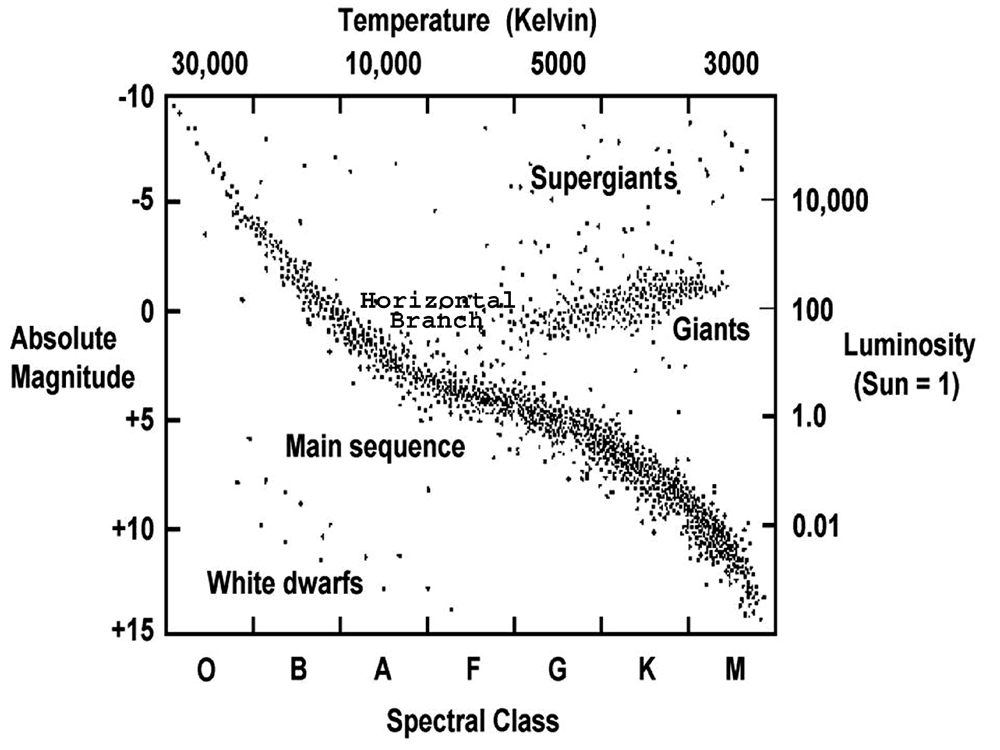
As shown in the HR-Diagram, White Dwarfs are some of the hottest objects in the universe, and as stated by agtoever there has not been enough time for even the oldest white dwarf to have cooled passed something like 4800K.

Sunday, 1 May 2011

tidal forces - When did the Moon stop?

"Protection" isn't the only effect of Earth. Here is a different POV: Earth may have accelerated impactors by gravity assist.


A different approch is the thinner crust, as suggested for the near side, which may have allowed asteroids to penetrate Moon's crust, such that lava could flow into the basins, or which may have favoured volcanism on the near side (see "Lunar interior" on this site).


A third approach is the protective property of Earth preventing the near side to be covered with many new craters, hence leave the maria visible.


According to Wikipedia the time to lock tidally is about
$$t_{mbox{lock}}=frac{wa^6IQ}{3G{m_p}^2k_2R^5},$$
with $$I=0.4m_sR^2.$$
For Moon $k_2/Q = 0.0011$, hence
$$t_{mbox{lock,Moon}}=121frac{wa^6m_s}{G{m_p}^2R^3}.$$
With Earth's mass $m_p=5.97219cdot 10^{24}mbox{ kg}$, Moon's mass $m_s=7.3477cdot 10^{22}mbox{ kg}$, Moon's mean radius of $R=1737.10mbox{ km}$, $G=6.672cdot 10^{-11}frac{mbox{Nm}^2}{mbox{kg}^2}$we get
$$t_{mbox{lock,Moon}}=121frac{wa^67.3477cdot 10^{22}mbox{ kg}}{6.672cdot 10^{-11}frac{mbox{Nm}^2}{mbox{kg}^2}cdot{(5.97219cdot 10^{24}mbox{ kg})}^2(1737.10mbox{ km})^3},$$
or
$$t_{mbox{lock,Moon}}=7.12753cdot 10^{-25}wa^6 frac{mbox{kg}}{mbox{Nm}^2 mbox{km}^3}.$$
Parameters are $w$ the spin rate in radians per second, and $a$ the semi-major axis of the moon orbit.


If we take the the current simi-major axis of the moon orbit of 384399 km
and a maximum possible spin rate of
$$w=v/(2pi R)=frac{2.38 mbox{ km}/mbox{s}}{2picdot 1737.10mbox{ km}}=frac{1}{4586 mbox{ s}},$$
with $v=2.38 mbox{ km}/mbox{s}$, Moon's escape velocity, 1737.1 km Moon's radius,
we get
$$t_{mbox{lock,Moon}}=7.12753cdot 10^{-25}cdot frac{1}{4586 mbox{ s}}cdot (384399mbox{ km})^6 frac{mbox{kg}}{mbox{Nm}^2 mbox{km}^3}\
=501416mbox{ s}^{-1}cdot mbox{ km}^6 frac{mbox{kg}}{mbox{Nm}^2 mbox{km}^3}=
5.01416cdot 10^{14} mbox{ s}.$$
That's about 16 million years, as an upper bound.


If we assume a higher Love number for the early moon, or slower initial rotation, the time may have been shorter.


The time for getting locked is very sensitive to the distance Earth-Moon (6th power). Hence if tidal locking occurred closer to Earth, the time will have been shorter, too. That's likely, because Moon is spiraling away from Earth.