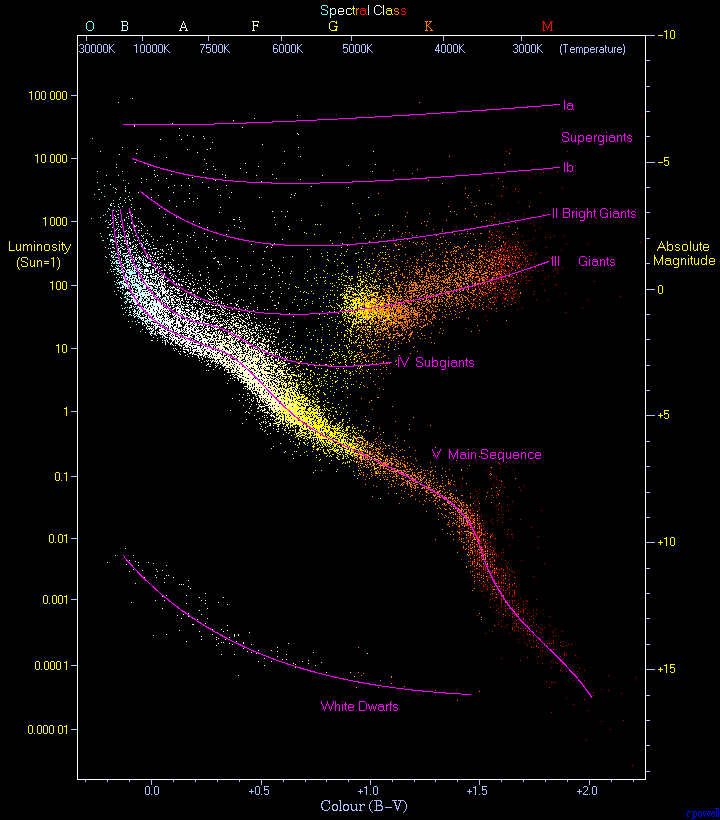
The answer depends on what you'd want to consider as a "star." If you're just thinking about stars on the main sequence, then you can just refer to the classical stellar type letters, "OBAFGKM" (which has relatively recently been extended to accommodate the coolest brown dwarfs with the letters "LTY"), where O-stars are the hottest stars (~30,000 K) and Y-stars are the coldest, so-called "room-temperature" stars (~300 K).
Self-gravitating, gaseous objects are incapable of fusing deuterium below about 13 Jupiter masses, and thus simply collapse and cool perpetually (as is the case for all the giant planets in our solar system). These objects can be colder than 300 K but are not technically stars as they do not undergo nuclear fusion.
For stars that leave the main sequence, two possible outcomes are a white dwarf star or a neutron star, both of which are born extremely hot: White dwarfs are born with surface temperatures of ~10^9 K, whereas neutron stars are born with surface temperatures of ~10^12 K. However, both white dwarfs and neutron stars cool as they age, with the coldest known white dwarfs being ~3,000 K, and neutron stars cooling to ~10^6 K.
So to answer the first part of your question: The coldest known stars are Y-stars (i.e. brown dwarfs) and the hottest known stars are either O-stars or young neutron stars, depending on whether you consider objects that have left the main sequence or not.
And as for strict lower and upper limits, the coldest stars possible are likely black dwarfs, which are what white dwarfs become after cooling for a very long time (>10^15 years). The hottest stars are likely the newly-born neutron stars I previously mentioned, it is very difficult to get much hotter than 10^12 K because any excess energy is carried away via neutrinos.

No comments:
Post a Comment