Saturday, 30 November 2013

ac.commutative algebra - equality of elements in localization via universal property [unsolved!]

I'm not sure I understand the question. More exactly, I think I disagree with what seems to be an assumption built into it: that there are sharp lines to be drawn between 'only using the universal property' and not, or between working 'without elements' and not.


Generally, a universal property describes how something interacts with the world around it. For example, if you say that an object $I$ of a category $mathcal{C}$ is initial, that describes how $I$ interacts with other objects of $mathcal{C}$. If you don't know much about the objects of $mathcal{C}$, it doesn't tell you much about $I$. Similarly, you're not going to be able to deduce anything about the ring $S^{-1}A$ without using facts about rings. I don't know which of those facts are ones you'd be happy to use, and which aren't.


There's nothing uncategorical about elements. For example, you're dealing with rings, and an element of a ring $A$ is simply a homomorphism $mathbb{Z}[x] to A$. (And $mathbb{Z}[x]$ can be characterized as the free ring on one generator, that is, the result of taking the left adjoint to the forgetful functor $mathbf{Ring} to mathbf{Set}$ and applying it to the terminal set 1.)


So I'm unsure what exactly your task is. But I'd like to suggest a different universal property of localization, which might perhaps make your task easier. Here it is.


Let $mathbf{Set}/mathbf{Ring}$ be the category of rings equipped with a set-indexed family of elements. Formally, it's a 'comma category'. An object is a triple $(S, i, A)$ where $S$ is a set, $A$ is a ring, and $i$ is a function from $S$ to the underlying set of $A$. (You might think of $i$ as an including $S$ as a subset of $A$, but $i$ doesn't have to be injective.) A map $(S, i, A) to (S', i', A')$ is a pair $(p, phi)$ consisting of a function $p: S to S'$ and a homomorphism $phi: A to A'$ making the evident square commute.


There is a functor $R: mathbf{Ring} to mathbf{Set}/mathbf{Ring}$ given by
$$
R(A) = (A^times to A)
$$
where $A^times$ is the set of units of $A$ and the arrow is the inclusion. Then $R$ has a left adjoint $L$, given by $L(S, i, A) = (iS)^{-1}A$. In other words, the left adjoint to $R$ is localization.

fourier analysis - Ocean Water math

This time I'm trying hard to be as specific as I can. Please don't close the thread, help me to make a specific question. Thanks.


The description of formula with formula itself:


The fft-based representation of a wave height field expresses the wave height h(x, t) at the horizontal position x = (x, z) as the sum of sinusoids with complex, time-dependent amplitudes:


formula (36)


where t is the time and k is a two-dimensional vector with components k = (kx, kz), kx = 2πn/Lx, kz = 2πm/Lz, and n and m are integers with bounds −N/2 ≤ n < N/2 and −M/2 ≤ m < M/2. The fft process generates the height field at discrete points x = (nLx/N,mLz/M). The value at other points can also be obtained by switching to a discrete fourier transform, but under many circumstances this is unnecessary and is not
applied here. The height amplitude Fourier components, ˜ h(k, t), determine the structure of the surface.


Another vesrion of the same formula:


formula


Here X is a horizontal position of a point whose height we are evaluating. The wave vector K is a vector pointing in the direction of travel of the given wave, with a magnitude k dependent on the length of the wave (l):


k =2p /lamda


And the value of h (K,t) is a complex number representing both amplitude and phase of wave K at time t. Because we are using discrete Fourier transformation, there are only a finite number of waves and positions that enters our equations. If s is dimension of the heightfield we animate, and r is the resolution of the grid, then we can write:


K = (kx,kz) = (2pn / s,2pm /s)


where n and m are integers in bounds –r/2 £ n,m < r/2. Note that for FFT, r must be power of two.


Questions:


  • How many k do I need? Does it mean, that k takes all possible values (on the grid I mean)?


  • And what do I get as a result - complex number that shows height and (what?) in concrete point so I need make computations for all points on the grid or the whole grid itself?


  • How to apply fft to this formula?


co.combinatorics - Why are planar graphs so exceptional?

(I think that the question of why planar graphs are exceptional is important. It can be asked not only in the context of graphs embeddable on other surfaces. Let me edit and elaborate, also borrowing from the remarks.)


Duality: Perhaps duality is the crucial property of planar graphs. There is a theorem asserting that the dual of a graphic matroid M is a graphic matroid if and only if M is the matroid of a planar graph. In this case, the dual of M is the matroid of the dual graph of G. (See this wikipedia article).
This means that the circuits of a planar graph are in one to one correspondence with cuts of the dual graph.


One important manifestation of the uniqueness of planar graphs (which I believe is related to duality) is Kasteleyn's formula for the number of perfect matchings and the connection with counting trees.


Robust geometric descriptions: Another conceptual difference is that (3-connected or maximal) planar graphs are graphs of convex 3-dimensional polytopes and thus have extra geometric properties that graphs on surfaces do not share.


The geometric definition of planar graphs (unlike various generalizations) is very robust. A graph is planar if it can be drawn in the plane such that the edges do not intersect in their interiors and are represented by Jordan curves; The class of planar graphs is also what we get if we replace "Jordan curves" by "line intervals," or if we replace "no intersection" by "even number of crossings". The Koebe-Andreev-Thurston theorem allows to represent every planar graph by the "touching graph" of nonoverlapping circles. Both (related) representations via convex polytopes and by circle packings, can respect the group of automorphisms of the graph and its dual.


Simple inductive constructions. Another exceptional property of the class of planar graphs is that planar graphs can be constructed by simple inductive constructions. (In this respect they are similar to the class of trees, although the inductive constructions are not so simple as for trees.) This fails for most generalizations of planar graphs.


A related important property of planar graphs, maps, and triangulations (with labeled vertices) is that they can be enumerated very nicely. This is Tutte theory. (It has deep extensions to surfaces.)


It is often the case that results about planar graphs extend to other classes. As I mentioned, Tutte theory extends to triangulations of other surfaces. Another example is the fundamental Lipton-Tarjan separator theorem, which extends to all graphs with a forbidden minor.


The study of planar graphs have led to important graph theoretic concepts Another reason (of a different nature) why planar graphs are exceptional is that several important graph-theoretic concepts were disvovered by looking at planar graphs (or special planar graphs.) The notion of vertex coloring of graphs came (to the best of my knowledge) from the four color conjecture about planar graphs. Similarly, Hamiltonian paths and cycles were first studied for planar graphs.


Graphs on surfaces and other notions generalizing planarity. Considering the class of all graphs that can be embedded in a given surface is a natural and important extension of planarity. But, in fact, for various questions, graphs embeddable on surfaces may not be the right generalization of planar graphs.


David Eppstein mentioned another generalization via the colin de Verdier invariant. This describes a hiearachy of graphs where the next class after planar graphs are "linklessly embeddable graphs". Those are graphs that can be embedded in space without having two disjoint cyles geometrically link. As it turned out this is also a very robust notion and it leads to a beautiful class of graphs. (They all have at most 4v-10 edges where v is the number of vertices; The known case of Hadwiger's conjecture for graphs not having K_6 minor implies that they are all 5 colorable.) Further classes in this hierarchy are still very mysterious. Other extensions of planarity are: 3) (not literally) Graphs not having K_r as a minor; 4;5) (Both very problematic) As Joe mentioned, graphs of d-polytopes, and also graphs obtained from sphere packings in higher dimensions; 6) (not graphs) r-dimensional simplicial complexes that cannot be embedded in twice the dimension, 7) [A notion that I promoted over the years:] graphs (and skeleta) of d-polytope with vanishing second (toric) g-number, and many more.


Forbidden minors and coloring. As for the second and third items in the question. About coloring I am not sure if we should consider 4-coloring planar graphs and coloring graphs on other surfaces as very related phenomena. Regarding forbidden minors. Kuratowski's theorem on surfaces is a special case (and also an important step of the proof) of a much more general result (Wagner's conjecture proved by Robertson and Seymour) about any minor-closed class of graphs. This result can be regarded as extending Kuratowski theorem and also (and perhaps more importantly) extending Kruskal and Nash-Williams theorem on trees. Indeed Kuratoski's theorem is related nicely to the more general picture of topological obstruction to embeddibility. If you would like to propose a different (perhaps topological) understanding of the extension of Kuratowski's theorem for surfaces, then maybe you should start by the well-quasi ordering theorem for trees.

Friday, 29 November 2013

nt.number theory - Why is the Gamma function shifted from the factorial by 1?

I would also go for $Pi(t)$ or $t!$, but a possible reason to prefer the shifted version, $Gamma(t)$, is the following. The gamma densities $gamma_t$, $tin mathbb{R}$ defined as


$$gamma_t(x):=frac{x_+^{t-1}e^{-x}}{Gamma(t)},$$


are a convolution semigroup, so that $Gamma(t)$ appears naturally as the normalization factor of $gamma_t$. (And, of course, the semigroup relation


$$gamma_t*gamma_s=gamma_{t+s}$$


would be destroyed shifting from $t-1$ to $t$ in the definition of $gamma_t$)


Also note that the expression of the Beta function


$$B(t,s):=int_0^1 x^{t-1}(1-x)^{s-1} , dx$$


in terms of the $Gamma$ function, if shifted, would also loose the useful form


$$B(t,s)=frac{Gamma(t)Gamma(s)}{Gamma(t+s)}.$$


(incidentally note that this relation follows plainly from the semigroup property since as a general fact, the integral of a convolution of two functions is the product of their integrals).

mg.metric geometry - Dividing a square into 5 equal squares

The Wallace-Bolyai-Gerwien Theorem theorem says:


Any two simple polygons of equal area are equidecomposable


(where simple means no self intersections and equidecomposable means finitely cut and glued).


For your problem you can take the first polygon to be a unit square and the second to be a sqrt(5) by 1/sqrt(5) rectangle and apply this theorem. Then perform the remaining four cuts.


Also, the generalisation of your question is the 2d analogue of Hilbert's 3rd Problem which asks whether given any two polyhedra with equal volume can one be finitely cut and glued into the other. The answer here, unlike in the 2d case, is "no" which was proved by Dehn using Dehn invariants in 1900.

supermassive black hole - How can we infer the mass of SMBH in galaxies that are not active anymore?

I can think of two methods.


Both rely on the dynamics of material surrounding the SMBH, which is affected up to a distance of the order of the "sphere of influence". This is the region where the BH dominates the dynamics as compared to the enclosed mass of the galaxy. The sphere of influence is:


$$ R_{mathrm{infl}} equiv frac{G M_{mathrm{SMBH}}}{sigma_{mathrm{bulge}}^2} >> R_{mathrm{horizon}} approx R_{mathrm{Schwartzschild}} equiv frac{G M_{mathrm{SMBH}}}{c^2} $$


While typically $sigma_{mathrm{bulge}} approx 250 km s^{-1}$, it is well known that $c approx 300000 km s^{-1}$. This means that the influence of a BH can be felt much further away than its event horizon, which is where the accretion takes place. In fact the ratio between the two distances is about 1000000.


Exploiting this fact, astronomers have been using two methods to probe extragalactic*, quiescent SMBH:


  • The first method is to observe CO lines (radio astronomy) to trace gas circling the BH. The gas does not need to be near the event horizon, which is much smaller than the sphere of influence. In fact CO observations rely on the gas being relatively dense but cold. Essentially the speed at which the CO gas will rotate is a (quadrature) sum of the declining component due to the stellar mass, plus the Keplerian component due to SMBH mass.

  • The second method is completely analogous, but relies on measuring the unresolved kinematics of the stars surrounding the SMBH. This can be done in various bands, but most authors use visible line absorptions to measure the velocity and velocity dispersion (and other moments) of the stars in the regions surrounding the BH. If the kinematics cannot be explained without including a point mass in the middle, then you are done.

See this work, for a comparison of the two methods.


*(extragalactic means outside of our own galaxy)

nt.number theory - Interpreting Euler's Criterion for Idoneal Numbers

(I am a very, very new to mathematics, so I apologise in advance for posing a question so basic, but am out of ideas).


In Idoneal Numbers and some Generalizations, pp. 15, Ernst Kani quotes Euler's criterion for idoneal numbers:


An integer n ≥ 1 is idoneal if and only if for every k = 1,..., [√(n∕3)] with (k, n) = 1 we have that n + k2 = p, p2 , 2p or 2s, for some odd prime p and some integer s ≥ 1.


However, my interpretation of this criterion leads to false positives: non-idoneal integers being recognised as idoneal. Kani discusses that others were dissatisfied with this formulation, but it is my understanding that these criticisms are mainly theoretical. That is, the formulation above is supposed to correctly identify all known idoneal numbers.


I take k to be every value between 1 and √(n∕3) inclusive that is coprime to n. I assume k should only take integer values, but am unsure of how to round the square root, i.e. nearest, floor, or ceiling.


For every value of k I compute sum = n + k2. If sum is odd and prime, I take this to be the n + k2 = p result. If sum is a perfect square whose square root is prime, I take it to be the n + k2 = p2 result. If sum is even and sum∕2 is prime, I assume n + k2 = 2p. Lastly, if sum is a power of 2 whose exponent is ≥ 1, I assume
n + k2 = 2s.


I require one of the above results for each value of k to regard n as idoneal.


Let n = 36. √(n∕3) = 3.4641016151377544. Therefore, k = 1, 2, or 3. Only 1 is coprime to n, so this is k's sole value. n + k2 = p = 36 + 1 = 37. 37 is both odd and prime. This seems to satisfy the criterion as I understand it, but 36 is not an idoneal number. n = 100 is but one of other false positives.


Any clues on either how to interpret this criterion correctly or a better algorithm (short of brute force) to recognise idoneal numbers?

What percentage of visual stars are actually binary stars?

This is a difficult question, It's been changing through the years and it's difficult to calculate accurately. Now it's know that this percentage changes depending on the star type and ranges from 50% for Sun like stars up to a 80% for type O stars.


Fonts:


http://www.space.com/1995-astronomers-wrong-stars-single.html (2006)


http://www.space.com/22509-binary-stars.html (2013)

Wednesday, 27 November 2013

What is the angular diameter of Earth as seen from the Moon?

The average angular diameter of the Moon, as seen from the Earth, is about 31 arcminutes.


The angular diameter depends on the distance between the two objects and the diameter of the object being viewed. Specifically, for small angles, it is the diameter divided by the distance. When the distance is the same, the angular size is proportional to the diameter.


The distance remains the same when viewing the Earth from the Moon, but the Earth is larger. According to NASA, the diameter of the Moon is 3,476 km, and the diameter of the Earth is 12,756 km.


So, because it's proportional, the angular diameter can be calculated as follows:


$a_{Earth} = a_{Moon} times {d_{Earth}over d_{Moon}}$


$ = 31 arcminutes times {12,756 km over 3,476 km}$


$ approx 114 arcminutes$, or just under 2 degrees.


This is approximate, because not only is this valid only for small degrees, where the tangent of an angle can be approximated by the angle itself (in radians), the Earth-Moon distance varies because the Moon's orbit around the Earth is an ellipse.

notation - Mathematical symbols, their pronunciations, and what they denote: Does a comprehensive ordered list exist?

Often, certain symbols in mathematics denote different things in different fields. Is there any sort of ordered list that will tell you what a certain symbol means in alphabetical order by the symbol's alias in LaTeX, perhaps with the way to pronounce it out loud?


I'm thinking of something like this Wikipedia page but more comprehensive and usefully ordered by LaTeX alias (The one on wikipedia has very few symbols, and I am familiar with all of them already). The problem is that when you want to find the meaning of a symbol, there is no way to search on google (because google has no support at all for searching for symbols). Oftentimes, I'm forced to ask someone around the department what it means or how to say it out loud.


For example, I'm trying to find the meaning of the symbol $uplus$, but I have no way of finding out what it means. Also, for the longest time, I couldn't figure out what to call $f_!$ or $f^!$. How should I know that they're called "f lower shriek" or "f upper shriek".


So for the question: Does any such list exist for either pronunciation, meaning, or both (aside from the one on Wikipedia that I just noted)?

Tuesday, 26 November 2013

What is the predominant element in the dust of the Sombrero Galaxy?

I think that first, we have to properly appreciate the size of the Sombrero Galaxy. It is roughly 50,000 light years (15 kilo parsecs) in diameter. That might be only half of the diameter of our own Milky Way galaxy, but still makes each and every pixel on the photograph you're attaching in your question stretch more than 100 light years in distance.


That's a huge distance, so we can probably agree that clouds made of nearly anything and at least as dense as what you'd on average expect the interstellar medium to be comprised of, would obscure even the strongests light sources within that galaxy. This is important to realize, so we somewhat lower your expectations; These areas aren't tightly packed with anything, we're just talking of such vast distances that the light has to travel through, that even almost nothing will be enough to stop it from shining through.


Now to your question what it is comprised of. It is in essence matter from the interstellar medium that stops this light from reaching us, so nothing in particular that you wouldn't expect also in similar areas between stars within our Milky Way, or indeed any other galaxy that is roughly in the same age period of its development. Since the Sombrero Galaxy isn't even all that far away in cosmological sense, merely around 29 million light years, it has an apparent magnitude of ~ 9 and is a rather good target for observations of even hobbyist astronomers with enthusiast telescopes. More importantly though, you aren't looking that far into the past. Again, in the cosmological sense. For comparison, our Sun is roughly 4.5 billion years old, and we're observing the Sombrero Galaxy as it was 29 million years ago.


So what is this interstellar medium made of? On average, it is comprised of mostly gas clouds of hydrogen and helium forming during the primordial nucleosynthesis (read: Big Bang) and at most a few percent of heavier trace elements, some also in gas form and an itsy-bitsy percentage of these would combine into even heavier dust particles, mostly made of carbon, silicon, and oxygen (source for the interplanetary dust composition: NASA APOD). Remember, when I say clouds and dust, they are incredibly thin. So thin, you'd have to be traveling at a significant portion of C to even notice it much, unless you're looking for it with extremely sensitive equipment, like Voyager 1 and 2 do, for example. But even with such low particle density, some regions would be slightly denser, and some slightly thinner. And that is what creates that majestic dust lane of the Sombrero Galaxy.


They are interstellar medium, mostly made of primordial hydrogen and helium, and dust made of carbon, silicon, oxygen and other trace elements, and all of it hundreds of light years in length and obscuring light from the galaxy's stars to penetrate through at varying levels, depending on background light strength, proximity, and local interstellar medium cloud density. The color of the cloud says nothing of its composition. It is mostly black with parts of it shifting towards red hues due to molecules of gas and dust in the interstellar medium scattering blue light from the source of light more than they scatter red light. I.e. the same reason why the Sun or the Moon appear more red when they're low on the horizon.

photography - If I have amateur astrophotography image data that might be of scientific value, what should I do?

It depends, as you say, on the subject matter. For instance, images useful in variable star study can be provided to the AAVSO http://www.aavso.org/ and images relating to asteroids can be provided to the IAU Minor Planet Center. http://www.minorplanetcenter.net/ Other subject matter will be accepted elsewhere.


However, for the images to be useful in scientific fields, you will need to comply with the submission instructions, which a casual snap probably will not comply with. On the MPC guide for beginners there is a list of 44 technical suggestions for submitting scientific data: http://www.minorplanetcenter.net/iau/info/Astrometry.html The AAVSO has a tutorial in six chapters on photometry using a DSLR camera (and another for astro CCD cameras) http://www.citizensky.org/content/dslr-documentation-and-reduction


If you just want to get it out there and have people comment on what is in it, post it to Google+.

how did James Bradley discover light aberration?


That is a horrible value.


That value for aberration of starlight is "horrible" in two ways: One, in that's is very small. And two, in that it's large enough to interfere with parallax measurements.


In the late 1600s, scientists had already adopted the heliocentric model, and so were looking to measure the distance to the stars via parallax. Robert Hooke was among the first to attempt it, and probably the first to claim a measurement of the parallax. His observations were not very convincing at that time, but he probably did observe some effects from aberration of starlight (though they didn't know such a thing existed back then).


In the early 1700s, Bradley attempted to make a more precise measurement of parallax, and did obtain significant data, but the variations in the star positions were out of phase with the model. Using the speed of light estimate by Ole Roemer from Hooke's time, he correctly proposed that this was not parallax, but a speed-of-light phenomenon, now known as the aberration of starlight.


More info here:


http://arxiv.org/pdf/1208.2061.pdf


It took another century, until early 1800, for Bessel to measure the first parallax.


Basically, aberration of starlight produces the same variation in the positions of all stars, a periodic elliptic "wobble" that is the same for all stellar objects. Parallax produces a similar kind of wobble, but the amplitude depends on the distance to the star, and the phase is different from the aberration's.


There are also other effects, such as nutation, which introduce further perturbations.


http://cseligman.com/text/history/bradley.htm


Aberration per se is easy to explain via the old analogy to running through the rain. When you're standing, rain falls vertically. When you're running, rain appears to come from a different direction. Same with starlight. Like in this diagram (by Professor Courtney Seligman, linked above):


enter image description here


Now, small as that value is, it's still 20 arcsec. The resolving power of early telescopes (and modern amateur telescopes) is 1 arcsec or better - which is more than enough. What you need is a very solid mount with good setting circles. Lacking that, you could build a telescope with a fixed position, very rigid, forever pointing at the same place in the sky - that's what Hooke did - and then you're only limited by resolving power.


In any case, the precision required was quite doable with 1700s technology. An amateur could do it today, at very low cost - what you need is persistence to follow through with a long term project.


Could the effect of parallex, proper motion and light aberration of a
star be separated clearly?


Sure. Aberration is always the same. Parallax depends on the distance, and the phase is different.


EDIT:


Why is their phase different? They all have a one year period.


Go to the site by Prof. Seligman, link above, and look at the two diagrams showing the aberration and the parallax. In point B (in April), the star is in the middle of the ellipse due to parallax, but it's at the right-hand tip of the ellipse due to aberration.


Broadly speaking, parallax is a position-based effect, whereas aberration is a speed-based effect. It makes sense that they are out of phase by 90 degrees (remember trigonometry?)


Proper motion appears as a long-term drift of stellar positions that remains even after you subtract aberration, parallax, nutation, etc. There's a back-and-forth-back-and-forth from aberration and parallax, whereas proper motion keeps going in one direction only.


You could measure proper motion with relatively short term observations, but it only works for stars that are nearby and are moving fast. If you're willing to wait decades, proper motion is much more easy to measure.


EDIT:


Generally we should not worry about the light aberration, right?


Yeah, sort of. You know, at any given moment, the size and the direction of it. So you could simply subtract it from the measured position of the star you're watching.


OTOH, it was an additional source of error, until speed of light and the Earth's orbital parameters were very precisely determined. Perhaps it still contributes to the noise added to the data, to some extent - I'm not entirely sure here.

orbit - Does Earth revolves around Milky Way?

It is a composite movement.


Earth does not need to adjust anything: Earth's reference frame for orbiting is Sun, almost alone. You can take into account Jupiter, Saturn, Moon and that's pretty all. If you want to do things really really precise you use General Relativity and take into account Venus, Mars, Mercury, Uranus and Neptune. If you want even further precision you put into Dwarf planets and asteroids.


Only once you have all of that into account, you need to think "hey, there are other gravity forces out there", because Solar System's movement is almost rectilinear, 'cos the enormous radius of the orbit. So it affects almost exactly the same to Sun and Earth.


In resume, you can simply think "Earth orbits Sun, and idependently of that, the System moves towards the Apex".


About angular momentum, yes, there is a good amount of angular momentum in those movements. And also velocity: the sun moves through Milky Way at 72,000 kilometers per hour.

Monday, 25 November 2013

oc.optimization control - univariate prior corresponding to weighted sum of L1 and L2 penalties?

So here's my attempt at the algebra to find the normalizing constant:


$Z_{lambda,alpha} =displaystyleint exp( -lambda(alpha x^2 + (1 - alpha)|x| ) ) dx$


$ = 2 displaystyleint^{0}_{-infty} exp( -lambda(alpha x^2 + (1 - alpha)x ) ) dx$


$ = 2 displaystyleint^{0}_{-infty} exp( -lambda alpha x^2 -lambda (1 - alpha)x) dx$


$ = 2 displaystyleint^{0}_{-infty} exp(-ax^2-bx) dx$


where $a = lambda alpha$ and $b = lambda (1 - alpha)$. From Mathematica I get


$displaystyleint exp(-ax^2-bx) dx = frac{sqrt{pi}}{2 sqrt{a}} exp left( frac{b^2}{4a} right) mbox{erf} left( frac{2ax+b}{2 sqrt{a}} right)$


So continuing


$Z_{lambda,alpha} = left. 2 dfrac{sqrt{pi}}{2 sqrt{a}} exp left( dfrac{b^2}{4a} right) mbox{erf} left( dfrac{2ax+b}{2 sqrt{a}} right) right|^{0}_{-infty}$


$ = left. dfrac{sqrt{pi}}{sqrt{a}} exp left( dfrac{b^2}{4a} right) left( 2Phi left( sqrt{2} dfrac{2ax+b}{2 sqrt{a}} right) - 1 right) right|^{0}_{-infty}$


$ = left. dfrac{sqrt{pi}}{sqrt{a}} exp left( dfrac{b^2}{4a} right) left( 2Phi left( dfrac{2ax+b}{ sqrt{2a}} right) - 1 right) right|^{0}_{-infty}$


$ = left. dfrac{sqrt{pi}}{sqrt{a}} exp left( dfrac{b^2}{4a} right) left( 2Phi left( dfrac{2ax+b}{ sqrt{2a}} right) - 1 right) right|^{0}_{-infty}$


$ = 2 dfrac{sqrt{pi}}{sqrt{a}} exp left( dfrac{b^2}{4a} right) Phi left( dfrac{b}{ sqrt{2a}} right) $


$ = 2 dfrac{sqrt{pi}}{sqrt{alpha lambda}} exp left( dfrac{lambda^2(1-alpha)^2}{4lambda alpha} right) Phi left( dfrac{lambda(1-alpha)}{ sqrt{2lambda alpha}} right) $


$ = 2 dfrac{sqrt{pi}}{sqrt{alpha lambda}} exp left( dfrac{lambda(1-alpha)^2}{4 alpha} right) Phi left( dfrac{sqrt{lambda}(1-alpha)}{ sqrt{2 alpha}} right) $


Am I going wrong somewhere?

Finitely generated monoids are finitely presented?

Nobody has answered the actual question, though of course the preface to the question should say "any finitely generated commutative monoid is finitely presented in the sense that there is a coequalizer diagram $P_1 stackrel{to}{to} P_0 to M$ with $P_1$ and $P_0$ free commutative and finitely generated."


I believe the answer to the question is no, we cannot always find a presentation $P_1 to P_0 to M$ where $P_1$ maps to the kernel of $P_0 to M$.


However, I don't have a proof.

Sunday, 24 November 2013

astrophysics - Exploiting symmetry in the axisymmetric Jeans equations

Background: If $f(mathbf{x},mathbf{v},t)$ is the distribution function of the stars in phase space and $n = int f,mathrm{d}^3mathbf{v}$ is the star density, then in the cylindrical coordinates $(R,varphi,z)$, the $z$-component of the second of the Jeans equations applied to an axisymmetric system is
$$renewcommand{expv}[1]{langle{#1}rangle}partial_t(nexpv{v_z}) + partial_R(nexpv{v_Rv_z}) + partial_z(nexpv{v_z^2}) + frac{nexpv{v_Rv_z}}{R} + npartial_zPhi = 0text{.}$$
In a steady state, the first term vanishes, so if the positive and negative terms of the $z$-component of velocity terms balance, then so do the second and fourth, in which case:
$$partial_z(nexpv{v_z^2}) = -npartial_zPhitext{,}$$
which we can then integrate.


If the the star and mass distributions are axisymmetric and symmetric about the equatorial ($z = 0$) plane, then the potential has even symmetry in $z$, $Phi(R,z) = Phi(R,-z)$, and so does $n$. Thus their derivatives with respect to $z$ are odd functions, and $Phi_{,z}(R,z) = -Phi_{,z}(R,-z)$ implies
$$frac{1}{n}int_{-z}^z nPhi_{,z'},mathrm{d}z' = 0text{,}$$
since the integrand has odd symmetry. Hence,
$$frac{1}{n}int_z^infty nPhi_{,z'},mathrm{d}z' = frac{1}{n}int_{|z|}^infty nPhi_{,z'},mathrm{d}z'text{.}$$

Universe as 2d sphere surface - a round trip?

This is another case of taking an analogy too far (the other one I can think of is assuming that the rubber sheet analogy indicates that there is some extra spatial dimension$^1$). In this case, I'm assuming you're talking about the "balloon" analogy - the universe is expanding, like a balloon, but since there's no center, all bits of matter are on the surface of the balloon. This naturally leads to the idea that if you travel in one direction, you'll eventually come back to where you started. This is, unfortunately, not true.


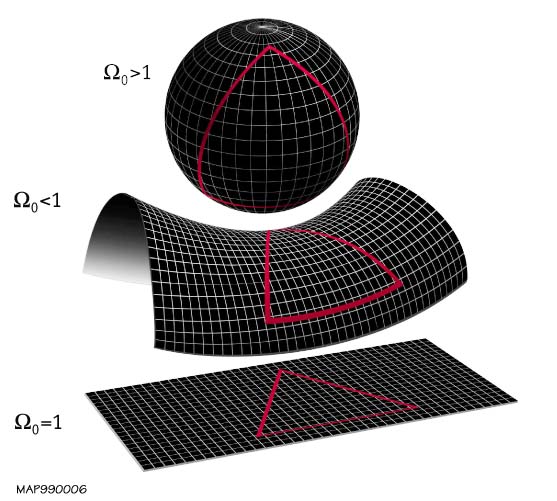
Scientists often talk about the shape of the universe - how it is curved on a local or global scale. There are three possible categories, depending on one parameter, $Omega$:


  • Positive curvature $to$ $Omega>1$

  • Zero curvature $to$ $Omega=1$

  • Negative curvature $to$ $Omega<1$

This diagram gives a good visual of each curvature:


Curvature


I should add that these are merely examples of universes (more accurately, manifolds) with each $Omega$. There are other cases with these curvatures, and so other universe where you can start at one point and end at the same point, as in a 3-torus.


All of these shapes could exist. However, in our universe, the global curvature is one where $Omega approx 1$ - a flat universe. The measurements that essentially clinch this are from the WMAP probe, which has analyzed the CMB and determined the age of the universe and its curvature. Measurements show, to a decent degree of accuracy, that our universe is flat - and so if we started in one direction, we would never return to where we started. Check out the NASA page for a full rundown of WMAP's results.


$^1$ Good questions dealing with this can be found here, here and here; John Rennie's answer on Physics is especially good.

Friday, 22 November 2013

fa.functional analysis - Generating cones having no surjections [in operator spaces]

Is this little toy known ?


Let $E$ be some Banach space, and let $K$ be the closed unit ball
of its dual, endowed with the weak-star topology. Also, let $j:E$ $rightarrow$ $C(K)$
be the natural embedding. Then, if $pi$ :$E$ $rightarrow$ $C(K)$
is onto, one must have $leftVert pi-jrightVert $ > 1. [Applying
this to $E=$ $ell^{1}$, or to $E=C[0,1]$ (eventually, via Milutin)
would be interesting, I think.]

Wednesday, 20 November 2013

soft question - How to transition from pure math PhD to nonacademic career?

Dear Maxim:


I gave this answer recently, based on a bunch of people that I personally know who went into non-academic fields. By the way, and I should mention this because I believe it's extremely relevant, these are all people based in the US (almost all are foreign-born in case you're wondering). Working in a non-academic field with a math phd is a lot more rare in my native France; your mileage may vary extremely depending on where you're trying to get a job.


The thing most of these people had in common is that they researched really carefully the career they wanted to do, and they took classes relevant for that career. It does not seem to matter what kind of math they did, and I believe most employers are not too bothered by how theoretical one is (quite the opposite, I suspect they may eye "applied" math with suspicion, as being less applicable then they think they are).


Your biggest challenge when looking for a job is selling yourself: for a non-academic job, it means really convincing your employer that your heart is in that career, that this is not a second-best for you.


Edit: to comment on your particular case further, I think you need urgently to figure out which of these fields is the best one for you, so that you spend your remaining year as efficiently as possible.

at.algebraic topology - Reference for equivalent definitions of the genus

Let $X$ be a (edit: nonsingular) projective complex algebraic curve. The genus of $X$ can be defined as the dimension of the space of holomorphic $1$-forms on $X$, which in turn can be defined either analytically or algebraically in terms of Kahler differentials. It can also be defined as the topological genus of $X$ considered as a surface, which in turn can be defined either topologically as the number of tori in a connected sum decomposition of $X$ or homologically in terms of the Betti numbers of $X$. Does anyone know of a reasonably self-contained reference where some or all of these equivalences are proven?


(There is a related question about computing the genus of a curve from its function field as well as a nice post by Danny Calegari explaining the relationship to the Newton polygon, but I am mostly interested in the algebraic-to-topological step of going from Kahler differentials to the number of tori in a connected sum decomposition.)

na.numerical analysis - A question about the lagrangian $L(x,lambda, nu)$ in the dual function in Convex Optimization

Hi.
My question is probably very simple to some of you that have experience in Convex Optimization.
The dual function is defined as the infimum of the lagrangian $L(x,lambda, nu)$ over all $x $ in the domain. The lagrangian is:
$f_0(x)+sum lambda_i f_i(x)+sum nu_i h_i(x)$


My question is, if $x $ is in the domain, it satisfies the equality constraints $h_i(x)$ and in that case, $h_i(x)=0$. So why do we even have to mention the equality constraints if they zero-out anyway?


Thanks a lot, I hope I wrote my question clearly.

nt.number theory - Is there an approach to understanding solution counts to quadratic forms that doesn't involve modular forms?

The best short reference for this is Lehman Math Comp 1992 PDF. A more elaborate discussion is in ME and ALEX which appeared in the Journal of Number Theory, January 2012, volume 132, number 1, pages 258-275. I attempted to include this material in a final section of the JNT paper, that did not work out, see META


A (ternary) positive quadratic form is indicated by $langle a,b,c,r,s,t rangle$ which refers to
$$ f(x,y,z) = a x^2 + b y^2 + c z^2 + r y z + s z x + t x y. $$ The discriminant is
$$ Delta = 4 a b c + r s t - a r^2 - b s^2 - c t^2. $$
Forms are gathered together into genera when they are equivalent locally. A fundamental result of Siegel is that we may calculate the weighted average of representations, over a genus, of a given target number. Siegel's result relates quadratic forms and modular forms.


We have genera labelled $G_1, G_2, G_3.$ Given an odd prime $p,$ define useful integers $u,v$ such that
$$ (-u | p) = -1, ; ; ; (-v | p) = +1. $$
The first one, $G_1,$ is the only genus of discriminant $p^2.$ Then we have two of the six genera of discriminant $4 p^2,$ these have level $4 p$ and are classically integral. Together
$$
begin{array}{lccccc}
mbox{Genus} & Delta & mbox{Level} & mbox{2-adic} & mbox{$p$-adic} & mbox{Mass} \
G_1 & p^2 & 4 p & y z - x^2 & u x^2 + p(y^2 + u z^2) & (p-1)/48 \
G_2 & 4p^2 & 4 p & 2 y z - x^2 & u x^2 + p(y^2 + u z^2) & (p-1)/32 \
G_3 & 4p^2 & 4 p & x^2 + y^2 + z^2 & v x^2 + p(y^2 + v z^2) & (p+1)/96
end{array}
$$
Note that $G_1$ and $G_2$ represent exactly the same numbers, but with different representation measures. Furthermore, when $p equiv 3 pmod 4,$ then $h(x,y,z) = x^2 + p y^2 + p z^2 in G_2,$ but
when $p equiv 1 pmod 4,$ then $h(x,y,z) = x^2 + p y^2 + p z^2 in G_3.$


Let $s(n)$ be the number of representations of $n$ as the sum of three squares. Then, taking one form $g$ per equivalence class in the specified genus, let
$$ R_j(n) = sum_{g in G_j} frac{r_g(n)}{|mbox{Aut} g|} .$$


The two new identities are
$$ s(p^2 n) ; - ; p s(n) ; = ; 96 ; R_1(n); - ; 96 ; R_2(n), $$


$$ (p+2) ; s( n) ; - ; s(p^2 n) ; = ; 96 ; R_3(n) .$$

nt.number theory - Quick proof of the fact that the ring of integers of Q(zeta_n) is Z[zeta_n]?

The ring of integers $R_n$ of ${mathbf Q}(zeta_n)$ contains ${mathbf Z}[zeta_n]$ as a subring with finite index. To show the containment of rings is an equality, it suffices to show the inclusion ${mathbf Z}[zeta_n] rightarrow R_n$ becomes an isomorphism after tensoring with ${mathbf Z}_p$ for all $p$, and this basically boils down to showing the ring of integers of ${mathbf Q}_p(zeta_n)$ is ${mathbf Z}_p[zeta_n]$ for all $p$. Now you have to know something about how to compute rings of integers in unramified and totally ramified extensions of local fields. I'm leaving off some details here, admittedly, and since I used the terrible word "compute" maybe this isn't an answer you are looking for.


You didn't tell us whether you were okay with the inductive argument but disliked (apparently) the prime-power case or you were unhappy with both aspects.

mp.mathematical physics - Uniqueness of Force Balancing Solutions

Consider some number of charged particles on a closed interval, each with possibly different amounts of charge. Assuming some kind of 'friction' to dampen their motion, they will eventually find a stationary equilibrium, where the repelling force from all the other charges is balanced (except in the case of the particles on the end points, which are also acted on by the 'walls'). It seems intuitively clear that this equilibrium depends only on the final ordering of the particles, but how does one show this? What is it about the interaction potential $frac{q_aq_b}{d}$ that makes this this solution unique?


I actually care about a slightly more complicated situation, which the previous example was meant to be a simplification of. Consider some number of charged particles on the unit circle in $mathbb{R}^2$, each with possibly different amounts of charge. However, the force between them behaves a little weird:


  • The repelling force between two particles is not constrained to the unit circle, it cuts across the circle along a chord and tries to push the particle along the straight-line connecting the two points. However, because the particles are constrained to the circle, the effective force is the projection of this vector to the tangent space to the circle.

  • The repelling force is proportional to the inverse of the distance between two particles (along the chord), not the inverse squared. Therefore, the potential is of the form $q_aq_bln(d)$.

It is then not hard to show the force exerted on particle $b$ by particle $a$ is proportional to $cotleft(frac{theta_b-theta_a}{2}right)$, and the potential is proportional to $lnleft(sinleft(frac{theta_b-theta_a}{2}right)right)$.


Again, it seems intuitively clear that, for a fixed cyclic ordering of the particles, there should be a unique equilibrium solution with all forces balanced (modulo rotation of the entire picture). However, how would one show this?


It seems like there should be well known tricks for how to do this, but I don't know much about this kind of stuff.

Sheaves and bundles in differential geometry

If $X$ is a manifold, and $E$ is a smooth vector bundle over $X$ (e.g. its tangent bundle),
then $E$ is again a manifold. Thus working with bundles means that one doesn't have to leave
the category of objects (manifolds) under study; one just considers manifold with certain extra structure (the bundle structure). This is a big advantage in the theory; it avoids introducing another class of objects (i.e. sheaves), and allows tools from the theory of manifolds to be applied directly to bundles too.


Here is a longer discussion, along somewhat different lines:


The historical impetus for using sheaves in algebraic geometry comes from the theory of several complex variables, and in that theory sheaves were introduced, along with cohomological techniques, because many important and non-trivial theorems can be stated as saying that certain sheaves are generated by their global sections, or have vanishing higher cohomology. (I am thinkin of Cartan's Theorem A and B, which have as consequences many
earlier theorems in complex analysis.)


If you read Zariski's fantastic report on sheaves in algebraic geometry, from the 50s, you will see a discussion by a master geometer of how sheaves, and especially their cohomology,
can be used as a tool to express, and generalize, earlier theorems in algebraic geometry.
Again, the questions being addressed (e.g. the completeness of the linear systems of hyperplane sections) are about the existence of global sections, and/or vanishing of higher cohomology. (And these two usually go hand in hand; often one establishes existence results about global sections of one sheaf by showing that the higher cohomology of some related sheaf vanishes, and using a long exact cohomology sequence.)


These kinds of questions typically don't arise in differential geometry. All the sheaves
that might be under consideration (i.e. sheaves of sections of smooth bundles) have global sections in abundance, due to the existence of partions of unity and related constructions.


There are difficult existence problems in differential geometry, to be sure: but these are very often problems in ODE or PDE, and cohomological methods are not what is required to solve them (or so it seems, based on current mathematical pratice). One place where a sheaf theoretic perspective can be useful is in the consideration of flat (i.e. curvature zero) Riemannian manifolds; the fact that the horizontal sections of a bundle with flat connection form a local system, which in turn determines the
bundle with connection, is a useful one, which is well-expressed in sheaf theoretic language. But there are also plenty of ways to discuss this result without sheaf-theoretic language, and in any case, it is a fairly small part of differential geometry, since typically the curvature of a metric doesn't vanish, so that sheaf-theoretic methods don't seem to have much to say.


If you like, sheaf-theoretic methods are potentially useful for dealing with problems,
especially linear ones, in which local existence is clear, but the objects are suffiently rigid that there can be global obstructions to patching local solutions.


In differential geomtery, it is often the local questions that are hard: they become difficult non-linear PDEs. The difficulties are not of the "patching local solutions"
kind. There are difficult global questions too, e.g. the one solved by the Nash embedding theorem, but again, these are typically global problems of a very different type to those that are typically solved by sheaf-theoretic methods.

Tuesday, 19 November 2013

the sun - Can looking at the sun through solar viewing eclipse shades everyday harm your eyes?

It depends on the quality of glasses and intensity, nature and degree of harmfulness of sunrays which you are watching to. Every eclipse has different intensity so as it can harm you.


When there was a solar eclipse around 3-4 years ago, it was a full solar eclipse. That time I watched it from my school with total naked eyes. My eyes were not harmed from that, but my school principle did.


But I still recommend you to not to watch it directly, use projectors which would allow you to get the view without directly watching the sun. Only use original products which are being certified.

the sun - When we see the Sun, do we actually see its past?

The speed of light in a vacuum is 299,792,458 meters per second, not infinite. Let's say, for example, particle of a beam of light, the photon, is emitted. It takes ~8 minutes to get to us; when it hits our eyes, we see it. This means that we see a photon that was emitted from the sun 8 minutes ago. We aren't, per se, looking "back in time", but we're looking at a photon that is ~8 minutes old.

Monday, 18 November 2013

nt.number theory - When does a rational function have infinitely many integer values for integer inputs?

If $F=P/Q$ is integral infinitely often then $F$ is a polynomial.


Write $$P(x)=f(x)Q(x)+R(x)$$ for some polynomial $R$ of degree strictly less than the degree of $Q$. If you have infinitely many integral $x$ so that $P/Q$ is integral then you get infinitely many $x$ so that $NR/Q$ is integral, where $N$ is the product of all denominators of the coefficients in $f$. However $R/Qto 0$ as $xto pm infty$ so $Requiv 0$ and so $Q(x)$ is a divisor of $P(x)$.


Now, as pointed out by Mark Sapir below, not all polynomials with rational coefficients take on integer values infinitely often (at integers), but you can check this in all practical cases by seeing if $dF$ has a root $pmod{d}$, where $d$ is the common denominator of the coefficients in $F$.

ac.commutative algebra - Does every projective A/I-module come from A?

Let $A$ be a Noetherian commutative ring and $I$ an ideal in $A$. It is pretty much trivial to see that every free $A/I$-Module is obtained from a free $A$-module by tensoring over $A$ with $A/I$: Just choose preimages for every generator and take the free module generated by them. I'm wondering whether the same remains true if I replace free by projective and finitely generated.


One way to prove this would be the following: Let $X=Spec A$, $Z=Spec(A/I)$, and $U=Z^c$. If there were something like a an exact sequence


$K_0(U) rightarrow K_0(X) rightarrow K_0(Z) rightarrow 0$


the claim would follow, right? Does such a sequence exist? If I'm not mistaken, such a sequence exists if A is a Dedekind ring. Just to make it clear, here is the precise question:


Question: Given a Noetherian commutative ring $A$, an ideal $I$ and a projective, finitely generated $A/I$-module $M$, does there exist a projective, finitely generated $A$-module $N$ such that $N/IN=M$?

enumerative combinatorics - Convex Polyhedra

Dear Ali,


Well there are various tools which are useful to the study of convex polytopes. The following list is perhaps not complete and it certainly should not be frightening. (I dont know very well various of these tools.)


1) Basic tools of linear algebra and convexity.


The notions of supporting hyperplanes, seperation theorems, Caratheodory, Helly and Radon theorem etc.


2) Combinatorics


Some of the study of convex polytopes translates geometric questions to purely combinatorial questions. So familiarity with combinatorial notions and techniques is useful.


3) Graph theory


As Joe mentioned the study of polytopes in 3 dimensions is closely related to the study of planar graphs. There are few other connections to graph theory so it is useful to be familiar with some graph theory.


4) Gale duality


The notion of Gale duality is a linear-algebra concept which privides an important technique in the study of convex polytopes.


5) Some basic algebraic topology


Euler's theorem and its higher dimensional analogues is of central imoprtance and this theorem is closely related to algebraic topology. Another example: there is a result by Perles that the [d/2]-dimensional skeleton of a simplicial polytope determines the entire combinatorial structure. (See this paper by Jerome Dancis.) The proof is based on an elementary topological argument. Borsuk-Ulam theorem also has various nice applications for the study of polytopes.


6) Some functional analysis


There is a result by Figiel, Lindenstrauss, and Milman that a centrally symmetric convex polytope in d dimension satisfies $$log f_0(P) cdot log f_{d-1}(P) ge gamma d$$ for some absolute positive constant $gamma$. The proof is based on a certain variation of Dvoretzky theorem and I am not aware of an alternative approach.


7) Some commutative algebra


Several notions and results from commutative algebra plays a role in the study of convex polytopes and related objects. Especially important is the notion of Cohen Macaulay rings and results about these rings.


8) Toric varieties


Understanding the topology of certain verieties called "toric varieties" turned out to be quite important for the study of convex polytopes.


All these items refer to general polytopes. There is also a (related) reach study of polytopes arising in combinatorial optimization. Here is a link to a paper entitled "Polyhedral combinatorics an annotated bibliography" by Karen Aardal and Robert Weismantel.


references


Here are some relevant references: Ziegler's book: Lectures on Convex Polytopes, and the second edition of Grunbaum's book "Convex polytopes" will give a very nice introduction to topics 1) - 4). The connection with commutative algebra and some comments and references to the connection with toric varieties (topics 7 and 8) can be found in (chapters 2 and 3 of) the second edition of Stanley's book "Combinatorics and Commutative Algebra". Relations with algebraic topology and with functional analysis can be found in various papers. This wikipedia article can also be useful.

homotopy theory - What are surprising examples of Model Categories?

Background


Model categories are an axiomization of the machinery underlying the study of topological spaces up to homotopy equivalence. They consist of a category $C$, together with three distinguished classes of morphism: Weak Equivalences, Fibrations, and Cofibrations. There are then a series of axioms this structure must satisfy, to guarantee that the classes behave analogously to the topological maps they are named after. The axioms can be found here.


(As far as I know...) The main practical advantage of this machinery is that it gives a rather concrete realization of the localization category $C/sim$ where the Weak Equivalences have been inverted, which generalizes the homotopy category of topological spaces. The main conceptual advantage is that it is a first step towards formalizing the concept of "a category enriched over topological spaces".


A discussion of examples and intuition can be found at this question.


The Question


The examples found in the answers to Ilya's question, as well as in the introductory papers I have read, all have a model category structure that could be expected. They are all examples along the lines of topological spaces, derived categories, or simplicial objects, which are all conceptually rooted in homotopy theory and so their model structures aren't really surprising.


I am hoping for an example or two which would elicit disbelief from someone who just learned the axioms for a model category. Along the lines of someone who just learned what a category being briefly skeptical that any poset defines a category, or that '$n$-cobordisms' defines a category.

galaxy - How many stars are visible to naked eyes around Equator area?

The numbers you're quoting are extreme, more like a theoretical limit, and meaningless in practice.


The 44k number would be true if you assume a limiting magnitude of 8. There aren't many people alive today who have seen at least one object at mag +8. This is not so much due to vision problems (although that may be important for some people), as to the fact that a mag +8 sky is an incredibly rare occurrence today due to light pollution.


If you live on a continent with a low population density (such as North America, Australia, or the remote parts of Asia), then yes, maybe you have a chance of catching a mag +8 sky - if you drive far out into the desert, many hours away from any city or town. But if you live in Europe or the like, forget it.


https://en.wikipedia.org/wiki/Light_pollution


http://www.jshine.net/astronomy/dark_sky/


Furthermore, the 44k number is obtained by assuming the mag 8 conditions, and then counting all known objects in the sky whose brightness exceeds that limit. It is very unlikely that any one person would see them all in one lifetime. Seeing even a single star at mag 8 can be a difficult undertaking for many people, even in ideal conditions.


It is very hard to quote a number, since it is so much dependent on light pollution, transparency, visual acuity of the observer (nearsighted people can't focus well enough to see very faint stars), the observer's age (acuity gets worse with age), the observer's experience (visual astronomers with years of experience will be able to see much fainter stars because they know how to look), etc.


If you're on a farm, away from cities, in a place with reasonably low light pollution, and your eyes are good, and you've been sitting in perfect pitch black darkness for at least 30 minutes prior - when you look up you can reasonably expect to see a few thousand objects, mostly stars. Keep looking, and after a while you will distinguish one or two thousand more stars, very faint, that you could not see at first sight. Practice this steadily for a few years, and you'll add maybe another thousand; but you won't be able to see those all at once - only one at a time.


Now travel to the Cerro Tololo site in Chile, up in the mountaineous desert, zero light pollution, excellent transparency, and you'll multiply all those numbers by a factor of 2x ... 5x.


As you can see, the numbers are very flexible because there are so many factors involved. You can't just slap a 44k label on it and call it a day; that doesn't make any sense in reality. Astronomers know that the pure magnitude number doesn't mean much by itself, because it is just one factor among many.


In a place with very high light pollution (like where I live, in the middle of a large, dense, sprawling urban area in California), you'd be lucky if you can see a hundred stars at night.


Or, in a place with zero light pollution, shine a flashlight into someone's face, and you've temporarily blinded them. You've reduced the number of stars they could see by an order of magnitude for the next half hour (night vision gradually recovers, and it takes 30 minutes to fully recover, according to US military manuals and visual astronomers practice).


Now, Equator versus poles.


The spin axis of the Earth has a fixed direction in space. The north - south axis always points at the same places in the sky, near Polaris in the north, and near the Southern Cross in the south.


For this reason, at the North Pole, you only ever see half the sky - the northern half, centered on Polaris. At the South Pole, you only see the other half. You'll never see Polaris from Australia.


At the Equator, you pretty much see the whole sky - not all at once, of course, but as the Earth rotates, it gradually exposes all parts of the sky at different times. However, the parts near Polaris and near the Southern Cross are always low in the sky and a bit hard to see.


So, bottom line is this:


In any place on Earth, in any given instant, you see exactly half of the sky. At the poles, that half is all you ever see. At the Equator, if you're patient, you'll eventually see the whole sky in time, as the Earth rotates and gradually exposes different parts of the sky at different times.

How many black holes exist?

There exists probably about one supermassive black hole per galaxy, hence about 100 billion ($10^{11}$) in the observable universe.


If we take 1% of the stars ending as a black hole as a very rough order of magnitude estimate, we'll get about 1 billion stellar black holes per galaxy, hence about $10^{20}$ stellar black holes in the observable universe, give or take one order of magnitude.


Stars of more than about 15 stellar masses (O class stars) will probably end up as black holes. About 0.00003% of the stars are O-class. The lifespan of a star with 15 solar masses is about 11.5 million years. So, we need to multiply the 0.00003% at least by a factor 1000, since the age of the universe is more than 1000-times the life of an O-class star, resulting in 0.03% of all stars over time should have been O-class stars.
(Most stars are red dwarfs, and have a longer life-span than the current age of the universe.) Star formation, especially of heavy stars, in the early universe has probably been higher than today.
Therefore I'm estimating the number of stellar black holes as about 1% the number of all stars.


Intermediate-mass black holes as presumed centers of globular clusters are harder to estimate, since there isn't much observational evidence. If the hypotheses turns out to be correct, and we take 1000 globular clusters per galaxy, we get about $10^{14}$ IMBHs.


There is no observational evidence for the existence of small black holes (smaller than a few solar masses).

How is it known that Callisto has no core?

It may have a (silicate) core, but it's very small. There also is the possibility of an internal liquid water "ocean". Currently the most probable composition is that of rock and ice, with the density of rock steadily increasing as one digs deeper (This is in stark contrast with planets like Earth, where there are discontinuities in the density between layers). Planetary differentiation has not occurred appreciably because Callisto is not tidally heated.


The composition can never be completely determined — the composition of a spherical body cannot be fully discerned from just rotation and translation1. However, we can make reasonable guesses. Basically, we can calculate its total mass and moment of inertia by observing its rotation and revolution. Then, assuming that the density ρ varies radially, we get the following two equations:


$$M = int rho pi r^2dr$$


$$I = int (rho pi r^2dr)r^2$$


These do not completely determine ρ, however with other reasonable assumptions on the composition and the amount of planetary differentiation it can have, we can get a good estimate for ρ.


1. It can be determined if we take a larger gravitational field and pivot it, but this ventures into the Aristotlean "Give me a place to stand on, and I will move the Earth." zone of thought experiments.

Sunday, 17 November 2013

special relativity - time on earth compared to completely stationary in space

Time dilation is a relative phenomenon, not a local phenomenon.


As adrianmcmenamin mentioned, Earth's motion around the sun is cause for no more time dilation than any other point in the universe. Consider that the sun is travelling around the galaxy at 200 km/s, and the Milky Way is approaching Andromeda at 130 km/s. We do not know at what speed we are approaching the great attractor, and I hope that at this point it becomes obvious that there is no difference in "us approaching the great attractor" to "the great attractor approaching us". Nothing is considered "stationary to the background" in an infinite, expanding universe as there is no "background" to measure against.


Consider the gedankenexperiment of comparing a clock on Earth to a clock orbiting the galaxy. Now compare those clocks to clocks outside the galaxy. You might consider the clock that ticks the most time away to be the "most at rest clock". Now I ask you, how will you compare the clocks? You must move at a significant portion of the speed of light for a very long time to get information from one clock to the next. Thus, the messenger would suffer the effects of Special Relativity, rendering the comparison meaningless.


To further the point, consider the development of International Atomic Time. I'll quote directly from wikipedia:


In the 1970s, it became clear that the clocks participating in TAI were ticking at different rates due to gravitational time dilation


Consider, those were clocks on Earth suffering from measurable time dilation due only to their latitude and altitude differences and the effect of moving information across the distances between them!

gn.general topology - Which topological spaces admit a nonstandard metric?

My question is about the concept of nonstandard metric space that would arise from a use of the nonstandard reals R* in place of the usual R-valued metric.


That is, let us define that a topological space X is a nonstandard metric space, if there is a distance function, not into the reals R, but into some nonstandard R* in the sense of nonstandard analysis. That is, there should be a distance function d from X2 into R*, such that d(x,y)=0 iff x=y, d(x,y)=d(y,x)
and d(x,z) <= d(x,y)+d(y,z). Such a nonstandard metric would give rise to the nonstandard open balls, which would generate a metric-like
topology on X.


There are numerous examples of such spaces, beginning with R* itself. Indeed, every metric space Y has a nonstandard analogue Y*, which is a
nonstandard metric space. In addition, there are nonstandard metric spaces that do not arise as Y* for any metric space Y. Most of these examples
will not be metrizable, since we may assume that R* has uncountable cofinality (every countable set is bounded), and this will usually prevent
the existence of a countable local basis. That is, the nested sequence of balls around a given point will include the balls of infinitesimal
radius, and the intersection of any countably many will still be bounded away from 0. For example, R* itself will not be metrizable. The space R* is not connected, since it is the union of the infinitesimal neighborhoods of each point. In fact, one can show it is totally disconnected.


Nevertheless, it appears to me that these nonstandard metric spaces are as useful in many ways as their standard counterparts. After all, one can still
reason about open balls, with the triangle inequality and whatnot. It's just that the distances might be nonstandard. What's more, the
nonstandard reals offer some opportunities for new topological constructions: in a nonstandard metric space, one has the standard-part operation,
which would be a kind of open-closure of a set---For any set Y, let Y+ be all points infinitesimally close to a point in Y. This is something
like the closure of Y, except that Y+ is open! But we have Y subset Y+, and Y++=Y+, and + respects unions, etc.


In classical topology, we have various metrization theorems, such as Urysohn's theorem that any second-countable regular Hausdorff space is metrizable.


Question. Which toplogical spaces admit a nonstandard metric? Do any of the classical metrization theorems admit an analogue for nonstandard metrizability? How can we tell if a given topological space admits a nonstandard metric?


I would also be keen to learn of other interesting aspects of nonstandard metrizability, or to hear of interesting applications.


I have many related questions, such as when is a nonstandard metric space actually metrizable? Is there any version of R* itself which is metrizable? (e.g. dropping the uncountable cofinality hypothesis)

elliptic curves - addition-theorem polynomials

Suppose a function f(u) identically satisfies an equation of the form G{f(u+v),f(u),f(v)}=0 for all u and v and u+v in its domain. Here G(Z,X,Y) is a non vanishing polynomial in the three variables with constant coefficients. Then one says that f admits an ALGEBRAIC ADDITION THEOREM. IF f(u) is cos(u), then


$G(Z,X,Y)=Z^2-2XYZ+X^2+Y^2-1,$


while, if f(u) is the Weierstrass p-function with invariants g_2 and g_3, then


$G(Z,X,Y)=16(X+Y+Z)^2(X-Y)^2 -8(X+Y+Z){4(X^3+Y^3)-g_2(X+Y)-2g_3}
+4(X^2+4XY+4Y^2-g_2)^2$


Here is the question: Characterize those polynomials G(Z,X,Y) which express an algebraic addition theorem.

nt.number theory - Binary Quadratic Forms in Characteristic 2

Starting, generally, with a commutative ring $R$ and a rank $2$ projective
module $P$ given with a quadratic form $varphi$ we can form its Clifford algebra
$C(P)$. Its even part $S:=C^+(P)$ is then a commutative $R$ algebra of rank $2$.
If (which we may assume locally) $P=Re_1+Re_2$ we have that $S$ has basis
$1,e_1e_2=:h$ and
$h^2=e_1e_2e_1e_2=e_1(langle e_1,e_2rangle-e_1e_2)e_2=langle e_1,e_2rangle h-e_1^2e_2^2=langle e_1,e_2rangle h-varphi(e_1)varphi(e_2)$,
where $langle-,-rangle$ is the bilinear form associated to $varphi$, giving an explicit
quadratic algebra over $R$. Furthermore, $C^-(P)=P$ and it thus becomes an
$C^+(P)$-module, explicitly
$hcdot e_1=e_1e_2e_1=langle e_1,e_2rangle e_1-e_1^2e_2=langle e_1,e_2rangle e_1-varphi(e_1)e_2$. Furthermore,
putting $L:=S/R$ we get an isomorphism $gammacolon Lambda^2_RP to L$ given by $uland v mapsto
overline{uv}$ (note that $u^2=varphi(u)$ which maps to zero in $L$). Note for future
use that, putting $[u,v]:=gamma(uland v)$, we also have $[[u,v]u,u]=varphi(u)[u,v]$, where
the left hand side is well-defined as
$[([u,v]+r)u,u]=[[u,v]u,u]+r[u,u]=[[u,v]u,u]$. We have therefore constructed
from $(P,varphi)$ a triple $(S,P,gamma)$, where $S$ is a quadratic (i.e., projective of
rank $2$) $R$-algebra, $P$ an $S$-module projective of rank $2$ as $R$-module
and an isomorphism $gammacolon Lambda^2_RP to S/R$ of $R$-modules. Conversely, given such a
triple $(S,P,gamma)$ there is a unique quadratic form $varphi$ on $P$ such that
$[[u,v]u,u]=varphi(u)[u,v]$ (where again the left hand side is well-defined). It is
easily verified that these constructions are inverse to each other.


In case $R=mathbb Z$ I hope this gives the usual association between forms and modules over orders in quadratic number fields (but I admit shamelessly that I haven't checked it). When $R=k[t]$ I again hope this gives what we want.


In terms of algebraic group schemes and torsors we have the following situation.
If the quadratic form is perfect, we have that $S$ is an 'etale covering and
hence corresponds to an element of $H^1(mathrm{Spec}R,mathbb Z/2)$. It is the
image under $O_2 to mathbb Z/2$ of the torsor in $H^1(mathrm{Spec}R,O_2)$
corresponding to $varphi$. As $mathbb Z/2$ also acts as an automorphism group of
$SO_2$ (by conjugation in $O_2$) we can use the torsor in
$H^1(mathrm{Spec}K,mathbb Z/2)$ to twist $SO_2$ to get $SO(varphi)$, the connected
component of $O(varphi)$. Torsors over this group corresponds to isomorphism classes
of pairs consisting of a rank $2$ quadratic $R$-forms $phi$ and an $R$-isomorphism
$C^+(phi)simeq S$. We have an alternative description of $SO(varphi)$: We can consider the
units $T:=S^ast$ of $S$ as an algebraic group and have a (surjective)
norm map $T to mathbb G_m$ and then $SO(varphi)$ is the kernel of this norm map.
Using the exact sequence $1to SO(varphi)to Ttomathbb G_mto1$ we see that an $SO(varphi)$-torsor
is given by a projective $S$-module $P$ of rank $1$ together with the
choice of an isomorphism $Lambda^2_RPsimeq R$.


[Added] Overcoming some of my laziness I did the calculation in the integral
case ($R=mathbb Z$ although the only thing we use is that $2$ is invertible):
Start with the quadratic form $Cx^2+Bxy+Ay^2$ (the switch between $A$ and $C$ is
to make my definition come out the same as the formula of the question). We then
have $h^2=Bh-AC$ so that $h=frac{B-sqrt{Delta}}{2}$. We have $hcdot e_1=Be_1-Ce_2$ and
$hcdot e_2=Ae_1$. This is just an abstract module over $S$ but we can make it a
fractional ideal by mapping $e_2$ to $A$, then $e_1$ maps to $h$ so that the
fractional ideal is indeed $(A,frac{B-sqrt{Delta}}{2})$.


[Added later] One could say that the association of the ideal $(A,h)$ to the
quadratic form $Cx^2+Bxy+Ay^2$ over the ring $R[h]/(h^2-Bh+AC)$ is an answer to
the question which workds in all classical cases ($R=mathbb Z$ and
$R=k[T]$). The reason that this looks simpler than the traditional ($R=mathbb
Z$) answer is that we let the presentation of the quadratic order depend on the
quadratic form itself. Usually we have fixed the quadratic order and want to
consider all forms with this fixed quadratic order as associated order. This
means that we should fix some normal form for the order and then express the
ideal in terms of this normal. When $R=mathbb Z$ orders are in bijection with
their discriminants $Delta$ which are actual integers (as the discriminant is
well-determined modulo squares of units). A normal form for the order is
$mathbb Z+mathbb Zsqrt{Delta}$ or $mathbb Z+mathbb Z(sqrt{Delta}+1)/2$ depending
on whether $Delta$ is even or odd. A curious feature of the form
$(A,frac{B-sqrt{Delta}}{2})$ of the ideal is that the distinction between the odd
and even case is not apparent. However, the crucial thing is that it expresses a
$mathbb Z$-basis for the ideal in terms of the canonical form of the quadratic
order.


The case of $R=k[T]$ for $k$ a field of odd characteristic is somewhat deceptive
as the discriminant $Delta=B^2-4AC$ is not quite an invariant of the quadratic order
as there are units different from $1$ that are squares (except when $k=mathbb
Z/3$!). Hence the formula $(A,frac{B-sqrt{Delta}}{2})$ is not quite of the same
nature as for the $mathbb Z$ case as there is a very slight dependence of $Delta$
on the form (and not just on the order). We could fix that by choosing coset
representatives for the squares as a subgroup of $k^ast$ and then the formula for
the ideal would would take the form $(A,frac{B-lambdasqrt{Delta}}{2})$ where $Delta$ now
has been normalised so as to have its top degree coefficient to be a coset
representative.


The case when $k$ has characteristic $2$ is more complicated. We get and order
of the form $k[T][h]/(h^2+gh+f)$ but the question of a normal form is trickier.
The discriminant of the order (in the sense of the discriminant of the trace
form) is equal to $g^2$ and as all elements of $k$ are squares we can normalise
things so that $g$ is monic. However, the order is not determined by its
discriminant. This can be seen already in the unramified case when $g=1$ when a
normal form for $f$ is that it contain no monomials of even degree and the
constant term is one of a chosen set of coset representives for the subgroup
${lambda^2+lambda}$ of $k$. We can decide to rather arbitrarily fix a generator $H$ for
every order with $H^2=GH+F$ where one sensible first normalisation is that $G$
be monic (for which we have to assume that $k$ is perfect). Then we have that $h=H+a$, with $ain k[T]$, and the ideal would be
$(A,H+a)$.


There is a particular (arguably canonical) choice of $H$: We assume $G$ is monic
and then can write uniquely $G=G_1G_2cdots G_n$ with $G_i$ monic and
$G_{i+1}|G_i$. The normal form is then that $F$ have the form
$F=G_1F_1+G_1^2G_2F_2+cdots+G_1^2G_2^2cdots G_nF_n+G^2F'$ where $deg F_i<deg G_i$ and
$F'$ contain no square monomials and its constant term belongs to a chosen set of
coset representatives for ${lambda^2+lambda}$ in $k$.


One further comment relating to the classical formulas. When passing from a
fractional ideal to a quadratic form one classically divides by the norm of the
ideal (as is done in KConrad's reply). This means that the constructed form is
primitive, i.e., the ideal generated by its values is the unit ideal. Hence if
one starts with a quadratic form, passes to the ideal and then back to a
quadratic form one does not end up with the same form if the form is not
primitive. Rather the end form is the "primitivisation" where one has divided
the form by a generator for its ideal of values. This of course only makes sense
if the base ring is a PID. Even for a general Dedekind ring if one wants to work
with primitive forms one has to accept quadratic forms that take values in
general rank $1$ modules (i.e., fractional ideals).


The approach above makes another choice. It deals only with $R$-valued forms but
accepts non-primitive ones. This would seem to lead to a contradiction as
the classical construction leads to a bijection between modules and primitive
forms and the above leads to a bijection between modules and arbitrary
forms. There is no contradiction however (phew!) as the above construction leads
to smaller orders than the classical one in the non-primitive case.


Classically what one really works with (when $R$ is a PID) are lattices in $L$
(the fraction field of $S$), where a lattice $M$ is a finitely generated
$R$-submodule of $K$ containing a $K$-basis ($K$ the fraction field of $R$) for
$L$. The order one associates to $M$ is the subring of $L$ stabilising $M$. When
the quadratic form $varphi$ is non-primitive $C^+(P)$ is not equal to this
canonically associated order but is a proper suborder by it. Dividing by a
generator for the ideal of values gives us a primitive form for which $C^+(P)$
is equal to the canonical order.


Finally there is a particular miracle that occurs for lattices in quadratic
extensions (of the fraction field of a Dedekind ring $R$), $M$ as a module over its stabilisation order is
projective. This is why classes of primitive forms with fixed order are in
bijection with the class group of the order.

Saturday, 16 November 2013

temperature - How is heat dissipated from a satellite or any metal in space?

Convection isn't a usable heat dissipating function in space, because there is no convecting medium.


Radiation, however, works extremely well. Any body in space will radiate in a wide range of wavelengths, and will also absorb radiation.


So any part of a space craft or satellite facing the sun will absorb heat (a net gain) and any facing away will radiate heat (a net loss).


Satellite designers minimise the absorption of energy by the use of reflective foil wherever possible, and provide heat radiating fins in order to dissipate excess heat on the dark side of the satellite.

Friday, 15 November 2013

reference request - Explicit computations using the Haar measure

The right or left Haar measures for a matrix group can be obtained in a completely straightforward manner with the aid of the right or left Maurer-Cartan form, respectively.


I will show the procedure for the stochastic group of invertible stochastic matrices (i.e., invertible matrices in $GL(B)$ whose rows sum to unity), though much of it generalizes in an obvious way. (The motivation I had for figuring this out is a gauge theory of random walks on the root lattice $A_n$ which I'll finish up one of these days.)


Let $R, R' in STO(B)$, and let $R$ be parametrized by (say) ${R_{jk}} equiv {R_{(j,k)}}$ for $1 le j le B, k ne j$. Now if


$left(mathcal{R}^{-1}right)_{(j,k)}^{(l,m)} := frac{partial(RR')_{(j,k)}}{partial R'_{(l,m)}} Bigg|_{R'=I}$


then the right Maurer-Cartan form on $STO(B)$ is
$omega_{(j,k)}^{(mathcal{R})} = mathcal{R}_{(j,k)}^{(l,m)}dR_{(l,m)}$.


Since the right Maurer-Cartan form is right-invariant, the right Haar measure is given (up to an irrelevant constant multiple) by


$dmu^{(mathcal{R})} = underset{(j,k)}{bigwedge} omega_{(j,k)}^{(mathcal{R})}.$


A similar construction yields the left Haar measure.


For a concrete example, let $B=2$. A straightforward calculation yields


$omega_{(1,2)}^{(mathcal{R})} = frac{(1-R_{21}) cdot dR_{12} + R_{12} cdot dR_{21}}{1-R_{12}-R_{21}}$


and


$omega_{(2,1)}^{(mathcal{R})} = frac{R_{21} cdot dR_{12} + (1-R_{12}) cdot dR_{21}}{1-R_{12}-R_{21}}$.


It follows that


$dmu^{(mathcal{R})} = omega_{(1,2)}^{(mathcal{R})} land omega_{(2,1)}^{(mathcal{R})} = frac{dR_{12} land dR_{21}}{lvert 1-R_{12}-R_{21} rvert}$.


(The modulus is taken in the denominator to ensure a positive rather than a signed measure.) Similarly, the left Haar measure is


$dmu^{(mathcal{L})} = frac{dR_{12} land dR_{21}}{lvert 1-R_{12}-R_{21}rvert^2}$.


Notice that both the right and left Haar measures assign infinite volume to the set of nonnegative stochastic matrices (i.e., the unit square in the $R_{12}$-$R_{21}$ plane). However, the singular behavior of the measures occurs precisely on the set of singular stochastic matrices. Indeed, for $0 le epsilon < 1$ consider the sets


$X_I(epsilon) := {(R_{12}, R_{21}) : 0 le R_{12} le 1-epsilon, 0 le R_{21} le 1 - epsilon - R_{12} }$


$X_{II}(epsilon) := {(R_{12}, R_{21}) : epsilon le R_{12} le 1, 1 + epsilon - R_{12} le R_{21} le 1 }$


and


$X(epsilon) := X_I(epsilon) cup X_{II}(epsilon)$,


i.e., $X(epsilon)$ is the unit square minus a strip of width $epsilon sqrt{2}$ centered on the line $1 - R_{12} - R_{21} equiv det R = 0$. Then


$int_{X(epsilon)} dmu^{(mathcal{R})} = 2(log epsilon^{-1} - 1 + epsilon)$


and


$int_{X(epsilon)} dmu^{(mathcal{L})} = 2(epsilon^{-1} - 1)$.


It is not hard to show that for $B$ arbitrary


$dmu^{(mathcal{R})} = lvert det mathcal{R} rvert underset{(j,k)}{bigwedge} dR_{jk}$,


and similarly for the left Haar measure. The general end result is


$dmu^{(mathcal{R})} = lvert det R rvert^{1-B} underset{(j,k)}{bigwedge} dR_{jk}, quad dmu^{(mathcal{L})} = lvert det R rvert^{-B} underset{(j,k)}{bigwedge} dR_{jk}$.


To see this, consider the isomorphism between the stochastic and affine groups and see, e.g. (N. Bourbaki. Elements of Mathematics: Integration II. Chapters 7-9. Springer (2004)).


Finally, a Fubini-type theorem (see, e.g., L. Loomis. An Introduction to Abstract Harmonic Analysis. Van Nostrand (1953)) applies to the special stochastic group $SSTO(B)$ (i.e., the subgroup of unit-determinant stochastic matrices). If for example elements of $SSTO(2)$ are parametrized by $R_{12}$, then $dmu = omega_{(1,2)} = dR_{12}$ is the (right and left) Haar measure. More generally, taking ${R_{jk}}$ for an appropriate choice of pairs $(j,k)$ as parameters for $SSTO(B)$, we have that $mathcal{R} = I = mathcal{L}$ and the Haar measure for $SSTO(B)$ is (up to normalization)


$dmu = underset{(j,k)}{bigwedge} dR_{jk}$.


This can easily be verified explicitly for small values of $B$ with a computer algebra package.


One simplifying feature of the simple stochastic group is that it is unimodular, so the left and right Haar measures coincide. Moreover, the Haar measure of the set of nonnegative special stochastic matrices is (finite, and w/l/o/g equals) unity. (For $SSTO(B)$, the constant multiplying the RHS of the equation above and that provides this normalization can be shown to be $((B-1)!)^{B-1}(B-2)!$.) Although this set is not invariant, it is a semigroup and it is obviously privileged in probabilistic contexts.

Thursday, 14 November 2013

knot theory - If the 4-genus of a link is zero, is it a slice link?

An n-component slice link is a link that bounds n disjoint discs in B^4. And the 4-genus of a link is defined to be the minimal genus of orientable surfaces bounded by it in B^4.


My question is: if the link bounds a surface with zero genus in B^4, is it necessarily a slice link? If not, any counter examples?

at.algebraic topology - How to compute the (co)homology of orbit spaces (when the action is not free)?

In general, this is a difficult question. Here are a couple of related facts that I know. Consider a discrete group G acting on a space X, which we will assume is a simplicial complex (and that the action is simplicial). Moreover, to simplify things assume that the stabilizer of a simplex stabilizes that simplex pointwise (this can be arranged by subdividing).


1) If X is simply-connected, then X/G is simply connected if and only if G is generated by elements that stabilize vertices. More generally, let H be the subgroup of G generated by vertex stabilizers (observe that this is normal!). There is then an exact sequence


1 --> H --> G --> pi_1(X/G) --> 1


This is a theorem of M.A. Armstrong; see his paper


MR0187244 (32 #4697)
Armstrong, M. A.
On the fundamental group of an orbit space.
Proc. Cambridge Philos. Soc. 61 1965 639--646.


A related theorem can be found in my paper "Obtaining presentations from group actions without making choices".


2) As far as homology goes, there is a whole theory of equivariant homology here. A good first place to read about it is Brown's book "Cohomology of Groups", Chapter VII, and a more comprehensive introduction is tom Dieck's book "Transformation Groups"


As you will see if you read the above sources, the answer comes down to "It's complicated!". In concrete settings, you are probably better off trying to get a good topological/geometric understanding of the orbit space with your "bare hands".

Wednesday, 13 November 2013

soft question - Refereeing a Paper

I think your question is so important as to deserve multiple answers, even if there is a good deal of overlap among them. (Indeed, overlap indicates that various respondents feel the same way about something, which is important.) So:


1) Should you summarize the main results and or the argument? If so, how much is a good amount? What purpose does this serve?


Absolutely yes. How much is hard to say: one thing I often do is try to put the paper down and write out a summary of the results (including precise statements) and the basic strategy of the proofs. This gives me something very longwinded. Then I try to pare it down until the point where cutting out anything else would be an obvious disservice to the author or to my explanation. It serves several purposes:


a) You need to have a high level grasp of what is being done in the paper. Writing out this summary allows you to gain this grasp (and this is especially important if the authors have done a bad job of indicating the importance of the paper in the introduction; I find that perfectly good papers are often not properly explained in this way) yourself,
and


b) You demonstrate to the author and editor that you have actually read, absorbed and digested the paper. (Or you demonstrate that you haven't!) This is important both as part of the decision process and also psychologically for the author: it is really maddening to get a paper rejected by a referee who you think didn't properly read it or understand it.


c) This factual information forms the basis for the opinions you will render later on.


2) What do you do when the journal requests you to evaluate the quality of the result (or its appropriateness for the journal)?


Then you evaluate the quality of the result and its appropriateness for the journal! This is the most important part of the refereeing process, and you should do it even if you aren't explicitly asked to. (It is very unlikely that the additional opinions you provide will be unwelcome. It is much more likely that you just didn't get sufficiently explicit instructions for whatever reason.)


Should one always make a recommendation regarding publication?


Yes. It needn't always be "absolutely yes" or "absolutely no" -- i.e., you can recommend publication conditional on the author's making certain changes (possibly without looking at the paper again, I mean) or you can recommend publication more or less strongly according to certain information that the editor has and you don't (e.g. backlog), but you should definitely make a specific and unambiguous recommendation.


3) What to do about papers with major grammatical or syntactical errors, but that are otherwise correct? Does it matter if the author is clearly not a native English speaker?


This is a tough one. I think if the errors are truly grammatical and/or syntactic and they are not so serious that they create ambiguity in the meaning or interfere with your undertanding of the paper, then this should be regarded as a "copyediting" issue and be clearly placed at a lower level of importance than matters of mathematical correctness or worth.


As an author, it can be annoying to have the recommendation for publication delayed by a referee who wants to make a big fuss about copyediting issues. (Even more annoying are referees who delve into issues of formatting. I have had referees ask me why certain things are italicized and one referee who sent me an entirely new copy of my paper with the font size changed. I felt that was silly.) By coincidence I got a referee report just this evening, and -- while it did point out a matter of content, for which I am quite grateful -- there were a lot of nagging little things, e.g. "Your notation for cyclic group seems odd to me." Okay, thanks for sharing.


Ideally, there will be an actual copyeditor who steps in after the paper is accepted. Some journals do this (mostly AMS and MAA journals, if memory serves).


4) On this note, at what point does one correct such mistakes? Ever? If there are fewer than a dozen? Should one be proof-reading the paper?


That's totally up to the discretion of the referee. You certainly have the right to do it but are not obliged to. I have myself done it sometimes for authors who are both junior and non-native speakers of English, because I think that they probably will both be happy to receive it and learn from it.


5) What do you do when you do not understand an argument?


Well, that's your biggest worry when you're refereeing a paper, isn't it? I can't give a complete answer here. Certainly you should be prepared to put a fair amount of effort into understanding a crucial point in the paper, including asking friends and colleagues about background knowledge, if appropriate. If after a while you still don't get it, you should say so in the report, and in my opinion you should make clear to what extent the author is at fault for the lack of understanding and what you want to be done about it. As an author, I have gotten comments from referees like "I don't understand the proof of Theorem 13." What am I supposed to do with that information? Tell me exactly what you didn't understand, or tell me that the whole argument is hopelessly vague or flawed, or tell me that you were honestly in a little over your head at this point. But tell me something.


Does it matter if it "feels" correct?


Yes, I think it does, but I don't feel comfortable saying more.


How long should one spend trying to understand an argument?


Again, there is no one good answer to this.


6) What to do about papers that have no errors but whose exposition is hard to follow?


I would say that if you can successfully ascertain that there are no errors, the exposition was not that hard to follow! Seriously, you can make as many specific suggestions/demands for expository changes as you like, but if you have actually understood and verified the paper, then rejecting it just because it is badly written is not a decision I would feel comfortable making as a referee. (As an editor, yes.)

nt.number theory - Unique factorization in polynomial rings

This doesn't fly. If the powers that be would like to delete the question, please go ahead. For my defense I'd like to add that I wanted to see whether my guess that most people would use the name Gauss in their answer holds water or not. So here's what I think I know.


Polynomials became mathematical objects through the work of the Italians (Cardano etc.);
after preliminary work done by Pedro Nunez, Simon Stevin showed that there is a Euclidean algorithm in polynomial rings that allows one to compute greatest common divisors. Strictly speaking it is difficult to separate unique factorization in ${mathbb R}[X]$ or ${mathbb C}[X]$ from the fundamental theorem of algebra, but certainly those who were working on the latter (d'Alembert, Euler) did not mention unique factorization anywhere.


The concept of unique factorization is due to Gauss (1801), although partial credit should be given to Euclid. Gauss proved that the rings $mathbb Z$ and ${mathbb Z}[i]$ are factorial, and did the same for ${mathbb F}_p[X]$ in his famous Section VIII of the Disquisitiones, which was published posthumously. Dirichlet realized in the 1840s that Euclidean domains are factorial and stated this as explicit as he could. But noone seemed to put 1 and 1 together to derive (1); my guess is that its essential content was known to people like Dirichlet, Eisenstein, Dedekind and Kronecker, but the result does not appear anywhere except much later when Weber wrote his textbook on algebra. Let me also add that Dirichlet could state that Euclidean rings are factorial even though the concept of an abstract ring came much later (he said something to the effect that if there is a Euclidean division algorithm, then you must have unique factorization no matter which "domain" you are working in).


Kronecker, in his lectures and, somewhat later, also in his publications, proved that the polynomial rings with finitely many variables and coefficients from $mathbb Z$ have unique factorization. The first explicit statement (and proof) of (2) that I know is in Hensel's article Über eindeutige Zerlegung in Primelemente, J. Reine Angew. Math. 158 (1927), 195--198. Again I guess that this wasn't exactly news for Emmy Noether or Artin, and the result is mentioned in just about every textbook on algebra, starting with van der Waerden's algebra published in 1930, which was based on lectures by Noether and Artin during the 1920s.


Corrections are welcome.